


Content Menu
● How We Selected Manufacturers
>> 1. Zhejiang Kingfit Environment Co., Ltd.
>> 2. Midea Building Technologies
>> 3. Gree Electric Appliances, Inc. of Zhuhai
>> 4. PHNIX Eco-Energy Solution Ltd.
>> 5. OUTES / Zhejiang Zhongguang Electrical Co., Ltd.
>> 6. Haier Smart Home / Haier HVAC
>> 7. Shenling Environmental Systems
>> 8. SPRSUN
>> 9. Fairland
>> 10. Guangda / Commercial and Industrial Heat-Pump Specialists
● Technical Evaluation Checklist
>> 1. Rated capacity is quoted under favorable conditions
>> 2. Component substitution after sample approval
>> 4. “Stainless steel” without grade disclosure
>> 5. Underestimated defrost performance
>> 6. Spare parts are not planned early
● Buyer’s Verification Process
>> Step 1: Define application conditions
>> Step 2: Compare technical submissions
>> Step 5: Lock specifications contractually
● FAQ
>> 1. How can I verify that an ISO 9001 certificate is still valid?
>> 2. Is CE certification enough for a heat pump sold in Europe?
>> 3. How should I compare two heat pumps with the same nominal kW rating?
>> 4. What is a realistic MOQ for private-label heat pumps?
>> 5. How can I prevent the supplier from changing components after I approve the sample?
China remains one of the world’s most important heat-pump manufacturing bases, supported by a mature HVAC supply chain, extensive compressor and component capacity, and strong engineering resources. The International Energy Agency notes that China leads global heat-pump manufacturing capacity, while a 2025 market report estimates the Chinese heat-pump market at USD 16.03 billion.
For overseas distributors, project contractors, and private-label brands, the practical question is not simply “Which factory is largest?” It is: Which manufacturer can consistently deliver the right product specification, verified performance, market-access documentation, and after-sales support for my target market?
This guide is designed for procurement teams evaluating residential air-to-water systems, heat-pump water heaters, commercial heating units, pool heat pumps, agricultural climate-control equipment, and industrial temperature-control solutions.
How We Selected Manufacturers
This list is not a ranking by sales volume alone. It uses buyer-oriented criteria that matter when building a stable supply relationship:
– Manufacturing foundation: Production facilities, technical teams, supply-chain control, and relevant product specialization.
– R&D and product scope: Ability to develop inverter systems, low-ambient heating, R290 refrigerant platforms, controls, hydraulic modules, and application-specific systems.
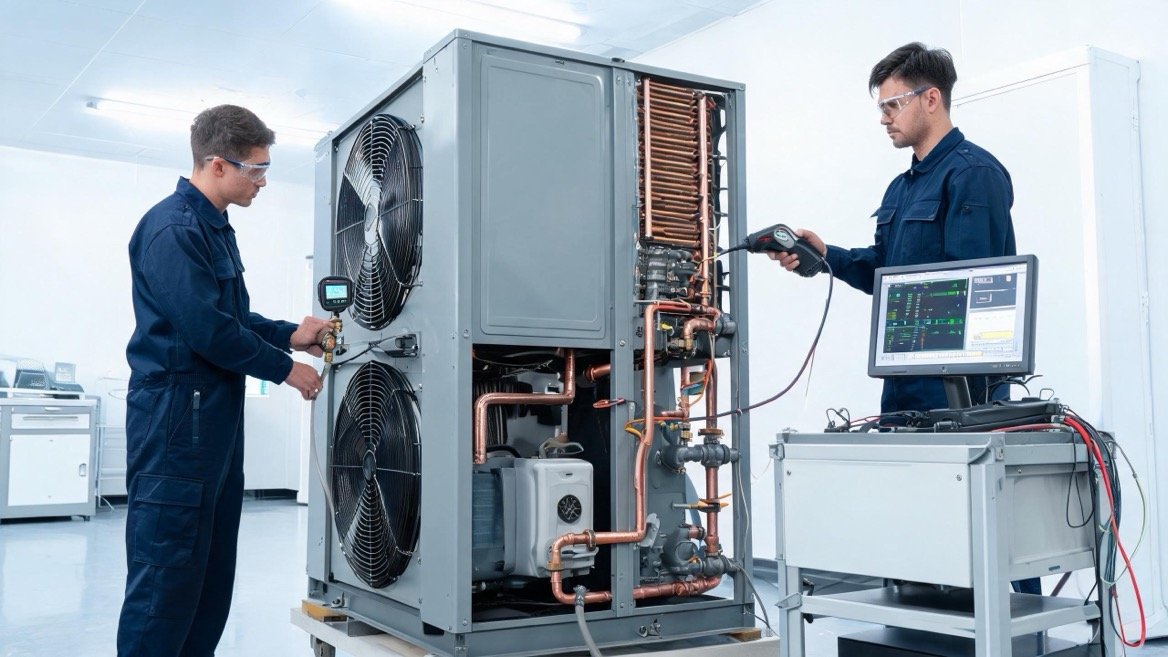
– Quality control: Incoming-component inspection, leak testing, electrical safety testing, running tests, performance validation, traceability, and final inspection.
– Export readiness: Availability of CE, RoHS, ErP, UKCA, ETL, AHRI, KEYMARK, MCS, or market-specific documentation where applicable.
– OEM/ODM suitability: Flexibility in branding, casing, controller logic, manuals, packaging, spare parts, certifications, and market-specific configurations.
– Delivery stability: Production planning, component sourcing, export packaging, container loading procedures, and communication responsiveness.
– Independent verifiability: Preference is given to manufacturers with information that can be checked through official company materials, certification databases, recognized test bodies, or industry sources.
A manufacturer’s certificate alone should never be treated as a blanket approval for every model. Buyers should verify that the legal entity, factory address, product series, rated capacity, refrigerant, and certificate validity match the exact product being purchased.
Why China Is a Major Source
China’s heat-pump ecosystem is concentrated across several established HVAC and appliance-manufacturing clusters:
– Guangdong: Foshan, Shunde, Guangzhou, and Zhuhai combine appliance manufacturing, electronics, sheet-metal fabrication, compressor supply, and export infrastructure.
– Zhejiang: Lishui, Taizhou, Ningbo, and Wenzhou support refrigeration equipment, industrial cooling, agricultural climate control, mechanical processing, and private-label manufacturing.
– Shandong and Qingdao: Strong base for household appliances, HVAC systems, export manufacturing, and marine logistics.
– Jiangsu and Anhui: Important locations for HVAC assembly, controls, refrigeration components, and large-scale heat-pump production.
China accounted for around 35% of global heat-pump manufacturing capacity in the IEA’s cited market analysis. The same analysis highlights China’s particularly strong compressor ecosystem, which matters because compressor performance, sourcing consistency, and control matching directly affect heat-pump reliability.
China’s total goods exports reached RMB 26.99 trillion in 2025, while equipment-manufacturing exports reached RMB 16.03 trillion, reflecting the scale of export-oriented industrial supply chains available to global buyers.
Top 10 Manufacturers
1. Zhejiang Kingfit Environment Co., Ltd.
Best suited for: Buyers seeking industrial cooling, agricultural intelligent climate control, commercial temperature-management systems, and flexible OEM/ODM cooperation.
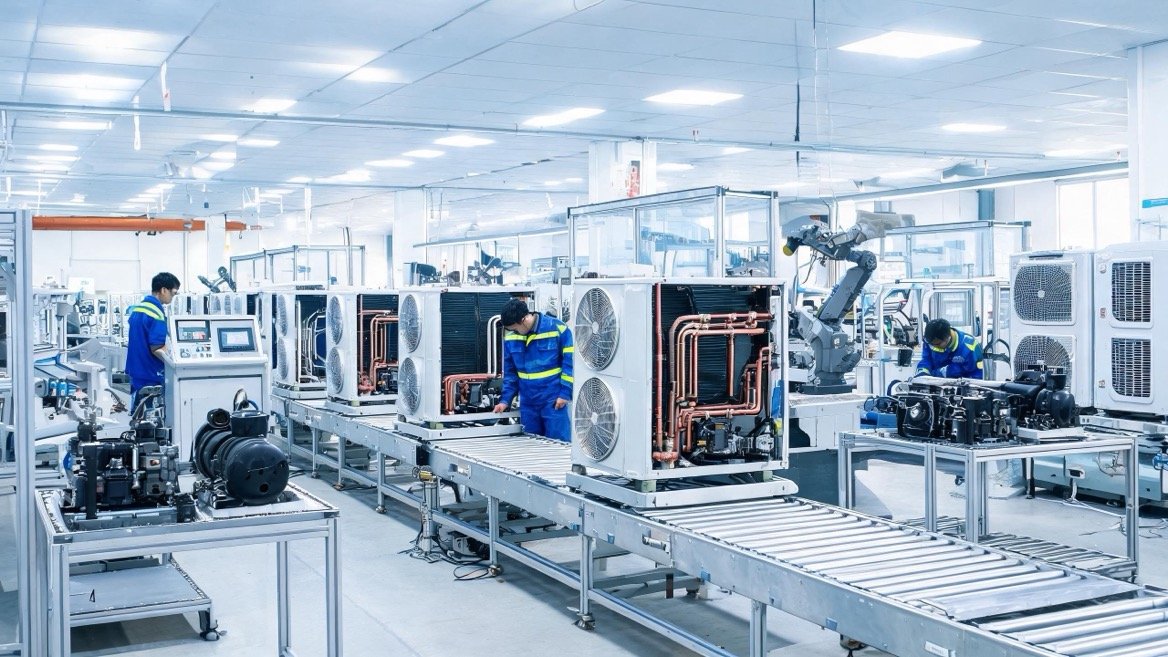
Founded from a refrigeration-service business established in 1998, Zhejiang Kingfit Environment Co., Ltd. developed through refrigeration equipment manufacturing before adopting its current corporate identity in 2014. The company operates from Lishui, Zhejiang, and reports a 40,000 m² production workshop with eight high-tech production lines covering screw chillers, maglev chillers, industrial chillers, climate-control units, grain coolers, heat-pump units, and cold-room cooling equipment.
Kingfit is distinct from consumer-appliance-focused suppliers because its product background is closely tied to industrial refrigeration, agricultural applications, grain cooling, and engineered temperature-control projects. This can make it a relevant option for buyers whose requirements go beyond standard residential monobloc units.
Core strengths
– Broad experience in industrial and agricultural temperature-control applications.
– Product portfolio spanning heat pumps, industrial chillers, screw chillers, cold-room systems, climate-control units, and grain coolers.
– Suitable for customers needing integrated temperature-control solutions rather than a single standard SKU.
– More accessible OEM/ODM approach for small and mid-sized international brands than some large consumer-appliance groups.
– Reported exports to more than 60 countries and 27 domestic offices.
– The company states that it invests 5% of annual income in R&D and works with agricultural and industrial consultants to improve products using customer feedback.
OEM/ODM scope to discuss
– Private-label product branding and carton design.
– Custom control logic for agricultural, cold-storage, food-processing, or industrial operating conditions.
– Capacity selection, electrical configuration, casing customization, interface requirements, and accessory matching.
– Project documentation, spare-parts packages, installation guidance, and application-specific system integration.
Buyer due diligence focus
For industrial or agricultural projects, request a clear technical package before sample approval: compressor brand and origin, heat-exchanger material, water-side pressure ratings, control strategy, ambient operating envelope, defrost logic, refrigerant charge, commissioning requirements, and project reference conditions.
2. Midea Building Technologies
Best suited for: Large distributors, HVAC contractors, and buyers needing broad product coverage, high-volume supply, and established overseas market access.
Midea is one of China’s largest HVAC and appliance groups, with heat-pump offerings across residential, commercial, and water-heating applications. For buyers prioritizing testing depth, Midea reported receiving 10 AHRI Performance Awards covering 2023–2025 across multiple HVAC categories, including unitary small heat pumps, packaged terminal heat pumps, VRF systems, chillers, and heat-pump water-heating equipment.
Midea’s heat-pump production line in Shunde was also recognized by SGS for its net-zero manufacturing assessment, including verification of production-process greenhouse-gas emissions for specific heat-pump lines.
Core strengths
– High-volume manufacturing and broad HVAC portfolio.
– Strong presence in residential, light-commercial, commercial, and hydronic-system segments.
– R290 product development for European and other regulated markets.
– Documented third-party certification activity through AHRI, Intertek, SGS, and KEYMARK-related records.
OEM/ODM scope to discuss
– Regional product configurations for distributors.
– Brand cooperation subject to volume and project requirements.
– Hydronic accessories, integrated tanks, controllers, and system bundles.
– Documentation localization and certification support for approved product platforms.
Buyer due diligence focus
Large suppliers may have higher MOQs and more structured product-change processes. Confirm whether your requested configuration is an existing certified model, a permitted derivative, or a new development project requiring fresh tests and documentation.
3. Gree Electric Appliances, Inc. of Zhuhai
Best suited for: Large-scale HVAC buyers, cold-climate projects, VRF applications, and distributors requiring an extensive technical portfolio.
Gree is a major HVAC manufacturer with heat-pump coverage in unitary, packaged, VRF, commercial, and water-heating categories. Its products have appeared in AHRI-recognized categories including water-cooled water-chilling and heat-pump water-heating packages, packaged terminal heat pumps, VRF systems, and related HVAC equipment.
Gree also reported an International Certification Enterprise Laboratory certificate from the China Quality Certification Centre, indicating that its lab was assessed for testing capability within the authorized scope.
Core strengths
– Comprehensive HVAC product range and large-scale production.
– Experience with low-temperature heating platforms and North American market-facing products.
– AHRI-recognized product categories and performance-program participation.
– Suitable for projects involving VRF, central HVAC, commercial heating, and standardized distribution models.
OEM/ODM scope to discuss
– Distributor-level product programs.
– Project-based HVAC equipment configuration.
– Regional voltage, control, and documentation packages.
– Technical support arrangements for larger commercial deployments.
Buyer due diligence focus
Do not assume a globally available model is approved for every local incentive or installation scheme. Ask for the exact SKU, test standard, market-specific certificate, and rated performance data at the temperature conditions relevant to your project.
4. PHNIX Eco-Energy Solution Ltd.
Best suited for: European air-to-water heat-pump programs, R290 systems, private-label importers, pool heat pumps, and water-heating projects.
PHNIX was founded in 2002 and specializes in heat-pump technology rather than treating it as a secondary appliance category. Its product range includes air-to-water heating, cooling and domestic hot water systems, commercial heat-pump water heaters, heat-pump water heaters, and inverter pool heat pumps.
PHNIX states that its product and company certification portfolio includes CE, UKCA, KEYMARK, AHRI, ETL, and ErP-related credentials for relevant products. It also reported passing AHRI performance audits at a 100% rate for three consecutive years from 2023 to 2025.
Core strengths
– Specialized heat-pump orientation.
– Strong focus on R290 air-to-water systems.
– Broad export-market certification coverage.
– Applicable to European private-label programs, where documentation and energy-label compliance are critical.
– Experience across residential heating, DHW, commercial water heating, and swimming-pool applications.
OEM/ODM scope to discuss
– Private-label air-to-water systems.
– Regional casing, user interface, branding, manuals, and packaging.
– Integrated hot-water solutions.
– Pool heat-pump product programs.
– Market-specific compliance packages.
Buyer due diligence focus
Confirm which certification covers the exact model and refrigerant version. For example, a certificate for an R32 model does not automatically support an R290 alternative, even if the casing and nominal capacity look similar.
5. OUTES / Zhejiang Zhongguang Electrical Co., Ltd.
Best suited for: Residential and commercial heating, integrated indoor-comfort systems, domestic hot water, and buyers that value large-scale R&D facilities.
OUTES was established in 2006 and produces air conditioners, heating and cooling heat pumps, domestic hot-water heat pumps, swimming-pool heat pumps, commercial heat pumps, ventilation equipment, and related indoor-comfort products.
The company reports a production base of more than 500,000 m² and intelligent laboratories approved by CNAS, TÜV, and Bureau Veritas. It also reports holding ISO 9001, ISO 14001, OHSAS 18001, CE, UL, ETL, RoHS, and REACH certifications, depending on product and market.
Core strengths
– Large integrated production footprint.
– Broad residential and commercial product coverage.
– Significant in-house laboratory capacity.
– Experience with industrial and agricultural cooling-and-heating applications in addition to residential products.
– Reported participation in developing national and industry standards.
OEM/ODM scope to discuss
– Branded residential heating systems.
– Pool and hot-water heat-pump ranges.
– Commercial heating solutions.
– White-label product packaging and export documentation.
– Smart controls and app-related configuration where available.
Buyer due diligence focus
Request independent test reports in addition to company laboratory reports, especially for claims around SCOP, seasonal efficiency, low-ambient capacity retention, and sound power.
6. Haier Smart Home / Haier HVAC
Best suited for: Buyers seeking a globally recognized appliance brand, integrated home-comfort systems, R290 product development, and established overseas channels.
Haier was founded in 1984, while Qingdao Haier New Energy Appliance Co., Ltd. was established in 2013 for product areas including electric water heaters, overseas heat pumps, and commercial heat pumps. Its listed heat-pump product documentation references RoHS, CB, CCC, ISO 9001, and CE for applicable products.
Haier has continued developing R290 air-to-water and air-to-air systems for Europe. Its newer commercial R290 monobloc range is positioned for offices, hotels, restaurants, gyms, and other light-commercial buildings, with reported water temperatures up to 80°C and a cascade capacity up to 320 kW.
Core strengths
– Established global appliance and HVAC presence.
– Strong integrated comfort-system positioning.
– Development activity in R290 residential and commercial heat-pump systems.
– Suitable for buyers needing standardized product platforms and broad market support.
OEM/ODM scope to discuss
– Distributor and regional product programs.
– Integrated heating, cooling, and domestic hot-water packages.
– System pairing with storage tanks and compatible HVAC equipment.
– Market-specific accessories and documentation.
Buyer due diligence focus
For higher-temperature commercial applications, ask for capacity and COP data at the specific leaving-water temperature required by the project. Performance at 35°C water is materially different from performance at 55°C, 65°C, or 80°C.
7. Shenling Environmental Systems
Best suited for: Commercial HVAC, modular chillers, air-source heat-pump solutions, hospitals, schools, hotels, factories, and engineered building projects.
Shenling is a China-based HVAC manufacturer known for commercial air-conditioning and system-level equipment. Its relevance for procurement teams lies in commercial heat-pump, chiller, air-handling, and building-environment applications rather than entry-level retail heat-pump products.
Core strengths
– Commercial HVAC and project-oriented engineering capability.
– Potential fit for modular heat pumps, integrated chillers, air handling, and large-building solutions.
– Better aligned with contractors, design institutes, and technical distributors than with low-MOQ private-label programs.
OEM/ODM scope to discuss
– Commercial model configurations.
– Project accessories and hydronic integrations.
– Regional electrical and control requirements.
– Technical documents for bidding and commissioning.
Buyer due diligence focus
For projects, do not buy only on unit price. Require a complete selection sheet including local design temperatures, load profile, redundancy strategy, hydraulic layout, sound requirements, electrical demand, and service-access constraints.
8. SPRSUN
Best suited for: Private-label buyers, residential air-to-water products, domestic hot-water systems, pool heat pumps, and smaller distribution programs.
SPRSUN is a heat-pump-focused supplier frequently included in China heat-pump market overviews, particularly for export-oriented air-source products and private-label supply. It appears in a market overview alongside Gree, Midea, Haier, and PHNIX as a notable industry participant.
Core strengths
– Heat-pump product specialization.
– Often relevant to buyers seeking more flexible cooperation than large appliance conglomerates.
– Product categories generally cover residential heating, DHW, and swimming-pool applications.
– Suitable for distributors developing their own branded product line.
OEM/ODM scope to discuss
– Logo, packaging, manuals, and controller display customization.
– Product configurations by voltage, frequency, refrigerant, and climate region.
– Spare-parts kits and service training materials.
– Smaller launch quantities compared with high-volume multinational brands.
Buyer due diligence focus
Private-label flexibility must be matched with strict control of model changes. Require written approval before any substitution involving compressors, expansion valves, pumps, PCB components, fans, insulation, or heat-exchanger materials.
9. Fairland
Best suited for: Swimming-pool heat pumps, inverter-driven pool climate systems, and buyers focused on pool-equipment distribution.
Fairland is most relevant for procurement teams sourcing swimming-pool heat pumps rather than whole-house hydronic heating systems. Its specialization makes it a candidate for pool-equipment distributors that require inverter technology, quieter operation, and dedicated product positioning.
Core strengths
– Pool heat-pump specialization.
– Suitable for distributors already serving pool builders, pool-equipment retailers, and hospitality projects.
– Potentially stronger fit for pool heating than manufacturers whose main business is domestic space heating.
OEM/ODM scope to discuss
– Pool-oriented housing color and branding.
– Local-market packaging and instructions.
– Connectivity, controller language, and warranty labeling.
– Matching with pool covers, filtration systems, or saltwater pool environments.
Buyer due diligence focus
Ask whether corrosion testing and warranty terms cover the intended water chemistry. Saltwater exposure, coastal installation, and improper bonding can cause failures that standard laboratory conditions may not fully represent.
10. Guangda / Commercial and Industrial Heat-Pump Specialists
Best suited for: Commercial hot-water projects, hotels, schools, dormitories, factories, food processing, and projects requiring high-temperature water.
China’s heat-pump market includes a large group of specialized commercial water-heating and industrial-temperature-control manufacturers beyond the major appliance groups. These companies can be viable sourcing partners for buyers with specific project needs, especially when standard residential monobloc products are not appropriate.
Core strengths
– Focused solutions for commercial hot water and process requirements.
– Often more willing to customize tank interfaces, water-pump arrangements, control logic, and multiple-unit cascade systems.
– Useful for hotels, worker dormitories, gyms, schools, food-service operations, and industrial applications.
OEM/ODM scope to discuss
– High-temperature water-heating configurations.
– Multiple-unit cascade systems.
– Buffer tanks, circulating pumps, control panels, and remote monitoring.
– Stainless-steel water-contact components and local electrical requirements.
Buyer due diligence focus
Commercial hot-water systems should be assessed as a system, not as a single heat-pump unit. Confirm daily demand, peak-hour demand, tank capacity, recirculation losses, incoming-water temperature, backup heating, Legionella-control strategy, and local installation regulations.
Manufacturer Comparison
| Manufacturer | Primary focus | Scale / production profile | Typical MOQ approach | Certifications to verify by model |
|---|---|---|---|---|
| Zhejiang Kingfit Environment | Industrial cooling, agriculture, grain cooling, heat pumps, cold-room systems | Reported 40,000 m² workshop and 8 production lines | Often more flexible for project and mid-sized OEM programs | ISO 9001, CE, CQC and project-specific documentation |
| Midea Building Technologies | Residential, commercial, hydronic, water heating | Large-scale global HVAC manufacturing | Usually medium to high, depending on program | CE, ErP, KEYMARK, AHRI, market-specific approvals |
| Gree | HVAC, VRF, commercial heat pumps, low-temperature systems | Large-scale integrated HVAC manufacturing | Usually medium to high | AHRI, CE, CSA, market-specific certifications |
| PHNIX | R290 air-to-water, DHW, pool, commercial water heating | Heat-pump-focused production | Medium; discuss private-label thresholds | CE, UKCA, KEYMARK, ErP, AHRI, ETL |
| OUTES | Residential and commercial heating, DHW, pool, ventilation | Reported 500,000+ m² integrated base | Medium to high | ISO 9001, ISO 14001, CE, UL, ETL, RoHS, REACH |
| Haier | Home comfort, air-to-water, commercial R290 | Large appliance and HVAC ecosystem | Usually medium to high | CE, CB, RoHS, ISO 9001, model-specific approvals |
| Shenling | Commercial HVAC and project systems | Project-oriented manufacturing | Project-based | CE, project and regional compliance documents |
| SPRSUN | Residential heating, DHW, pools, private label | Export-oriented heat-pump supplier | Often lower to medium | CE, ErP, RoHS, target-market approvals |
| Fairland | Swimming-pool heat pumps | Pool-equipment specialization | Medium, product-dependent | CE, RoHS, pool-market requirements |
| Commercial specialists | Commercial DHW and industrial heat | Application-specific production | Project-based | Electrical, pressure, sanitary, and market-specific approvals |
Technical Evaluation Checklist
A technically sound quotation should include more than nominal heating capacity. Buyers should request the following before comparing suppliers:
– Rated heating capacity at stated ambient temperature and leaving-water temperature.
– COP and seasonal performance figures under the applicable test standard.
– Compressor brand, model, inverter architecture, and operating envelope.
– Refrigerant type, charge quantity, safety design, and service requirements.
– Plate heat exchanger or coil material, water-side pressure rating, and anti-corrosion strategy.
– Fan motor type, sound power level, sound pressure test distance, and acoustic measurement standard.
– Defrost method, defrost trigger logic, and performance under high humidity near 0°C.
– Hydraulic components, including circulation pump, expansion vessel, flow switch, safety valve, and backup heater.
– PCB supplier, controller language options, fault-code documentation, remote-monitoring capability, and firmware update policy.
– Incoming inspection, leak test, pressure test, electrical safety test, and final run-test procedure.
– Product traceability rules for serial numbers, key components, and production batches.
For Europe-facing R290 products, buyers should also verify safety documentation, installation restrictions, technician requirements, transport classification, labeling, and market-specific compliance. R290 offers a very low global-warming potential, but it is flammable and therefore requires appropriate system design and installation procedures.
Common Sourcing Risks
1. Rated capacity is quoted under favorable conditions
A supplier may quote output at 7°C ambient and 35°C water, while your installation needs −7°C ambient and 55°C water. These conditions are not comparable.
How to avoid it: Request a full performance table showing capacity, power input, COP, and sound data at your actual design points.
2. Component substitution after sample approval
The sample may contain a recognized compressor, pump, fan, or controller, while mass production uses an alternative component with a similar nameplate rating.
How to avoid it: Add a locked bill of materials to the purchase agreement. Require written approval before changes to compressors, PCBs, heat exchangers, expansion valves, fans, pumps, insulation, or refrigerant components.
3. Certificate mismatch
A supplier may provide a valid CE, KEYMARK, ErP, or ETL document, but it may cover another factory, capacity, refrigerant, product platform, or discontinued model.
How to avoid it: Check the certificate number in the issuer’s public database where available. Match the legal manufacturer, factory address, model number, test standard, issue date, expiry date, and product configuration.
4. “Stainless steel” without grade disclosure
The phrase “stainless steel” alone is insufficient. Grade, thickness, weld treatment, and water chemistry compatibility matter.
How to avoid it: Specify the required grade, such as SUS304 or SUS316L where appropriate, plus thickness, corrosion conditions, and inspection method. This is especially important for hot-water tanks, coastal installations, pool water, and aggressive process water.
5. Underestimated defrost performance
A heat pump can perform acceptably in dry cold weather but struggle in damp conditions around −2°C to 5°C, where frost accumulation can be frequent.
How to avoid it: Ask for defrost-control logic, coil temperature sensors, defrost duration, drainage design, and reference performance from humid winter conditions.
6. Spare parts are not planned early
A supplier may offer an attractive unit price but have no structured spare-parts policy or may require long lead times for PCBs, sensors, valves, and inverter boards.
How to avoid it: Negotiate a recommended two-year spare-parts list before the first order. Include PCB assemblies, sensors, fan motors, pumps, contactors, valves, controllers, and common service items.
An Overlooked Buyer Tip
One of the least discussed risks is the difference between a laboratory-tested prototype and a repeatable mass-production configuration.
A sample can pass performance testing with carefully selected components and optimized firmware. However, a production batch may vary if the factory changes compressor suppliers, PCB revisions, fan motors, refrigerant charging equipment, heat-exchanger suppliers, or control parameters.
Before scaling an order, ask the manufacturer:
1. Is this exact configuration frozen for the next 12 months?
2. Which components are designated as “no substitution without written approval”?
3. Can you provide serial-number traceability for compressors, PCBs, and key safety components?
4. Will the first mass-production batch be subject to pre-shipment inspection?
5. Can an independent inspector witness functional testing and review quality records?
This process is especially valuable for importers launching a private-label brand, because warranty costs tend to appear months after installation rather than at factory acceptance.
Buyer’s Verification Process
Step 1: Define application conditions
Before requesting quotations, prepare a clear technical brief:
– Destination country and applicable regulations.
– Product type: monobloc, split, DHW, pool, commercial water heating, industrial process, agricultural control, or cold storage.
– Ambient temperature range and humidity conditions.
– Required leaving-water temperature.
– Voltage, frequency, plug, wiring, and local electrical requirements.
– Target annual volume and first-order quantity.
– Certification requirements.
– Branding, packaging, manual, app, and after-sales requirements.
Step 2: Compare technical submissions
Do not compare only nominal capacity and unit price. Build a matrix covering:
– Heating output at real design points.
– COP or SCOP under the intended standard.
– Refrigerant and safety design.
– Core component list.
– Water-side configuration.
– Noise data.
– Certifications.
– Warranty conditions.
– MOQ and lead time.
– Spare-parts pricing.
– OEM/ODM development cost and ownership of molds, manuals, software, and certifications.
Step 3: Verify the factory
Ask for a live video audit or third-party inspection covering:
– Incoming inspection area.
– Compressor and copper-tube storage.
– Brazing and welding process.
– Nitrogen purging practices during brazing.
– Leak detection and pressure testing.
– Refrigerant charging equipment.
– Electrical safety and running-test stations.
– Aging or burn-in procedures where applicable.
– Finished-goods warehouse.
– Packaging and container-loading procedures.
– Quality records for a recent production batch.
Step 4: Approve a sample
A sample should be evaluated in the same type of operating condition expected in the destination market. Record:
– Capacity and electricity consumption.
– Defrost behavior.
– Noise and vibration.
– Controller response.
– Installation convenience.
– Hydraulic connection layout.
– Manual quality and error-code clarity.
– Packaging protection.
– Remote-control or app functionality.
Step 5: Lock specifications contractually
The contract should identify:
– Approved model number and revision.
– Refrigerant type and charge.
– Locked bill of materials.
– Performance acceptance criteria.
– Required certifications.
– Inspection standard and sampling plan.
– Packaging requirements.
– Delivery schedule.
– Spare-parts package.
– Warranty responsibilities.
– Rules for engineering changes.
Logistics Considerations
Heat pumps are bulky, high-value equipment that require careful export planning.
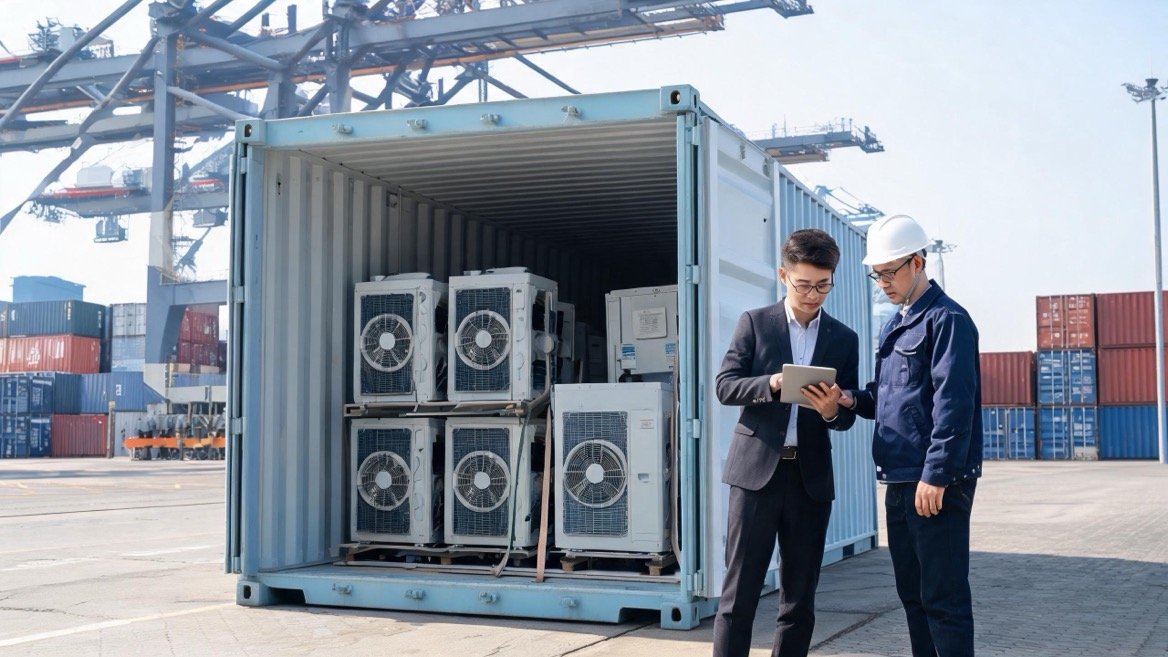
– Use reinforced export cartons, corner protection, moisture protection, and palletization where required.
– Confirm whether the equipment contains flammable refrigerant and ensure transport, labeling, and documentation comply with relevant dangerous-goods rules.
– For sea freight, verify container loading limits, pallet dimensions, stacking restrictions, and humidity protection.
– For R290 equipment, confirm carrier acceptance requirements before production is completed.
– Keep serial-number lists, packing lists, certificates, manuals, and spare-parts records organized by shipment.
– Consider purchasing spare controllers, sensors, valves, and PCBs with the first container rather than waiting for a warranty issue.
Conclusion
China offers a broad range of heat-pump suppliers, from global HVAC groups with extensive product certification to specialized manufacturers serving industrial, agricultural, pool, commercial hot-water, and private-label markets.
The best supplier for your business is not automatically the largest company or the lowest-priced quotation. It is the manufacturer that can demonstrate repeatable product quality, verifiable compliance, suitable engineering support, realistic lead times, stable core components, and a transparent response when technical questions arise.
For buyers seeking industrial refrigeration, agricultural climate control, grain cooling, cold-room equipment, and application-specific heat-pump systems, Zhejiang Kingfit Environment Co., Ltd. is worth evaluating as a flexible, engineering-oriented partner—particularly for projects and small-to-mid-sized brands requiring responsive communication and deeper OEM customization.
Before selecting any supplier, request a technical specification package, sample plan, certificate verification file, quality-control procedure, spare-parts proposal, and written component-control policy. A disciplined qualification process at the beginning is far less expensive than handling performance disputes or warranty failures after equipment reaches the market.
FAQ
1. How can I verify that an ISO 9001 certificate is still valid?
Ask for the certificate number, issuing certification body, legal company name, factory address, certification scope, issue date, and expiry date. Then verify it through the certification body’s directory where available. Also confirm that the certificate covers the actual manufacturing site, not only a trading company or a different affiliate.
2. Is CE certification enough for a heat pump sold in Europe?
No. CE is a conformity-marking framework, not a single universal performance certificate. Depending on the product and market, buyers may need to consider ErP requirements, energy labeling, safety documentation, EMC, RoHS, RED requirements for wireless products, pressure-equipment requirements, and country-specific programs. Confirm requirements with the importer of record and local compliance professional before ordering.
3. How should I compare two heat pumps with the same nominal kW rating?
Compare performance at the same test point: ambient temperature, humidity, leaving-water temperature, flow rate, and defrost condition. A “12 kW” unit may deliver very different output and power consumption at −7°C ambient with 55°C water compared with 7°C ambient and 35°C water.
4. What is a realistic MOQ for private-label heat pumps?
MOQ depends on the product platform, certification status, branding level, packaging, and component availability. Standard products with label and carton changes may have lower requirements than a custom casing, new controller language, modified hydraulic module, or new certification. Ask separately for sample MOQ, trial-order MOQ, repeat-order MOQ, and MOQ after the product is established.
5. How can I prevent the supplier from changing components after I approve the sample?
Attach an approved bill of materials and sample photo record to the purchase contract. Identify restricted components by manufacturer, part number, specification, and acceptable alternatives. Require written approval for substitutions, reserve the right to conduct pre-shipment inspection, and require batch traceability for key components.
References
– [International Energy Agency: Renewable Heat and Heat Pump Market Analysis] — The IEA identifies China as the world’s largest heat-pump market. [iea]
– [General Administration of Customs of the People’s Republic of China] — China reported RMB 26.99 trillion in goods exports in 2025. [customs.gov]
– [China Customs English Statistics] — Official export statistics by major commodity groups. [english.customs.gov]
– [European Heat Pump KEYMARK] — Useful for checking certificate validity for listed heat-pump products; an example Midea certificate references EN 14511, EN 14825, and EN 12102. [svt.sfzp]
– [AHRI Directory] — Use this directory to verify performance-certified HVAC equipment where applicable. Midea and Gree both report participation in AHRI-related performance programs. [midea]
– [OUTES Company Profile] — Manufacturer-reported information on production facilities, laboratories, certifications, and product coverage. [en.outes]
– [PHNIX Official Website] — Product categories and stated export-market certifications for air-to-water, DHW, commercial, and pool heat-pump ranges. [phnix-e]
Hot Tags: Heat Pump Manufacturers In China, China Heat Pump Factory, OEM Heat Pump Manufacturer, Air To Water Heat Pump Supplier, R290 Heat Pump Manufacturer, Commercial Heat Pump Supplier, Industrial Heat Pump Manufacturer, Heat Pump OEM ODM, China Heat Pump Exporter, Heat Pump Factory Audit