


Content Menu
● Liquid Chiller vs Air Chiller: Quick Comparison
● How Each Cooling Method Works
>> How Does a Liquid Chiller Cool a Process?
>> How Does an Air Chiller Cool a Process?
● Where Is the Cooling Needed?
>> Temperature Stability and Response
>> Is Liquid Cooling More Efficient Than Air Cooling?
>> What Belongs in a Lifecycle-Cost Review?
● An Expert Sizing Check Before You Request Quotes
>> Calculate a Preliminary Liquid-Cooling Load
>> Why a Peak-Load Snapshot Is Not Enough
● Three Design Details Buyers Often Miss
>> 1. The Fluid Circuit May Need Its Own Protection Plan
>> 2. An Air System Needs a Verified Air Path
>> 3. Controls Should Follow the Process, Not Just the Calendar
● Which Method Fits Your Industry?
>> Agricultural Environment Control
>> Food Processing and Cold-Chain Storage
● How to Choose the Best Cooling Method
>> Is an air-cooled liquid chiller an air chiller?
>> Which method provides more precise temperature control?
>> Does a liquid chiller always require cooling-tower water?
>> How do I estimate the required chiller capacity?
>> Is liquid cooling always cheaper to operate?
>> Can one facility use both liquid and air cooling?
>> What information should I send a cooling supplier?
In a liquid chiller vs air chiller decision, the first question is not which machine cools better. It is what must be cooled. A liquid chiller removes heat through circulating water or another process fluid. An air chiller, as used in this article, delivers cooled air to a process space or product. For industrial processes, the best method depends on how heat enters the product, the required temperature stability, site conditions, and the cost of operating the complete system.
There is an important terminology trap: an air-cooled liquid chiller still supplies chilled liquid to the process; it simply rejects heat outdoors through an air-cooled condenser. It is not the same thing as a system that cools a process directly with air. Keeping those two comparisons separate prevents an expensive specification error.
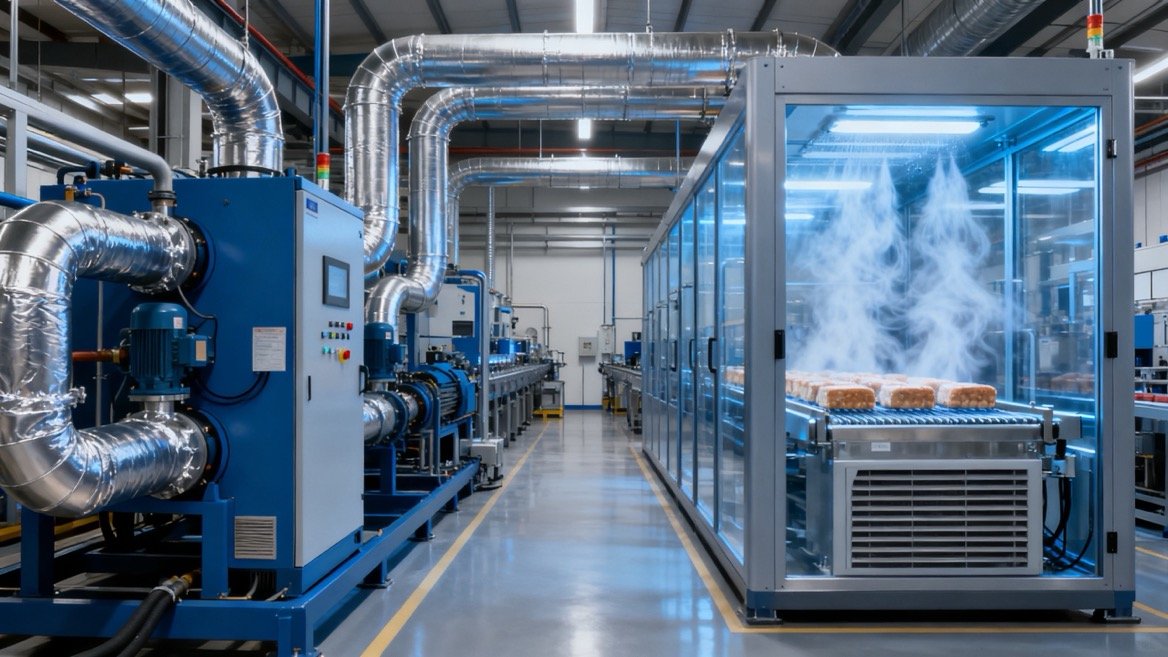
Liquid Chiller vs Air Chiller: Quick Comparison
| Decision factor | Liquid chiller | Air chiller or cooled-air system |
|---|---|---|
| Heat-transfer path | Circulating fluid absorbs heat through a jacket, plate, mold, or heat exchanger | Moving air absorbs heat from exposed surfaces or conditions an enclosed space |
| Best fit | Equipment and products with an accessible liquid heat-transfer path | Open products, rooms, cabinets, or processes designed around airflow |
| Temperature control | Can control fluid supply temperature and flow near the heat source | Depends on air temperature, airflow distribution, and contact with the load |
| Infrastructure | Pumps, piping, fluid treatment, and possible leak protection | Fans, ducts or enclosures, filtration, and airflow management |
| Main limitation | Poorly designed piping or fluid contact can undermine performance | Air may not reach enclosed or densely packed heat sources effectively |
| Typical buying mistake | Sizing the unit without measuring the process load | Assuming cold room air guarantees the required product temperature |
Neither column describes how a refrigeration unit rejects heat. Either system may involve equipment that ultimately rejects heat to outdoor air. Conversely, a liquid chiller may use a water-cooled condenser and cooling tower. The process-side cooling method and the condenser-side heat-rejection method are separate design choices.
How Each Cooling Method Works
How Does a Liquid Chiller Cool a Process?
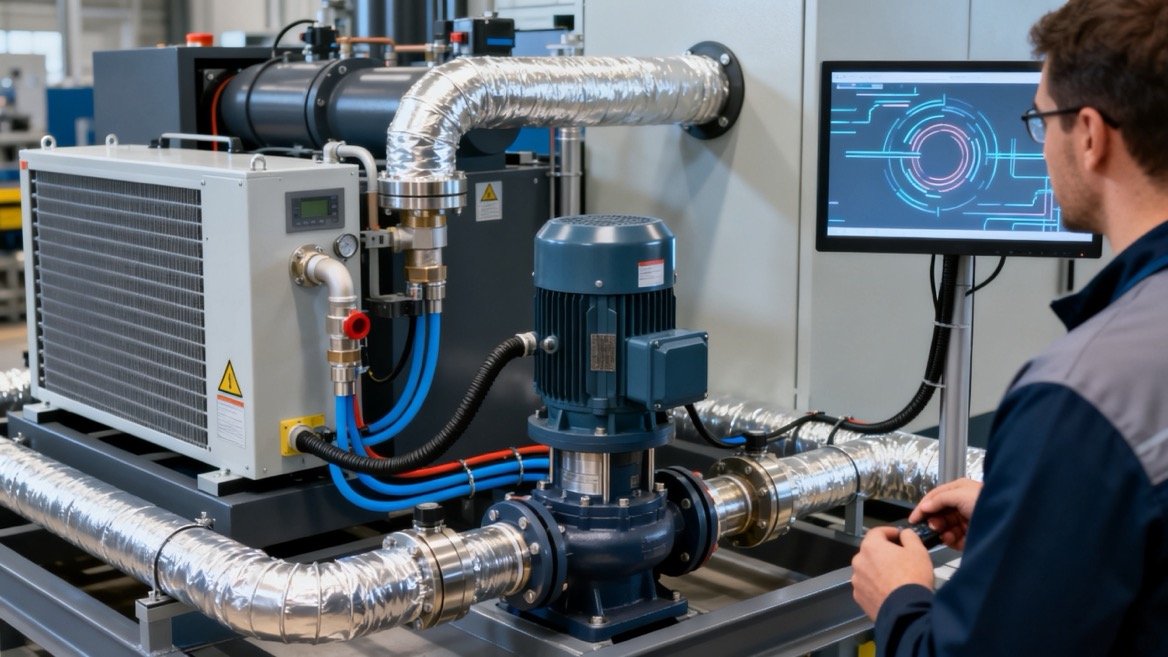
A liquid chiller circulates chilled water or a specified coolant through the process and returns the warmer fluid for cooling. Depending on the application, the fluid may pass through an equipment jacket, a mold, a heat exchanger, or a closed distribution loop. This approach gives designers a defined path between the cooling system and the heat source.
A refrigeration chiller commonly uses an evaporator to remove heat from the circulating fluid. Its condenser then rejects that heat to ambient air or to a separate condenser-water circuit. This is why “liquid chiller” does not automatically mean “water-cooled condenser.”
In practical specification work, I would start with the required temperature at the process connection, not the chiller’s advertised outlet temperature alone. Heat gain in piping, exchanger approach temperature, and changing production loads can all affect the temperature the process actually sees.
How Does an Air Chiller Cool a Process?
Here, an air chiller means a system that supplies cooled air to the load. Fans move air through a room, enclosure, tunnel, or other defined path so heat can transfer from exposed surfaces to the air stream. Its effectiveness depends heavily on where air enters, where it exits, and whether it can reach the surfaces that need cooling.
This makes cooled air useful when the space or exposed product is the target. It is less direct when heat is generated inside a sealed machine component or a product whose critical surfaces are shielded from airflow. A colder air-supply setting cannot, by itself, correct a blocked or uneven air path.
Where Is the Cooling Needed?
The most useful distinction is point-of-use cooling versus space or surface cooling.
A liquid loop can carry cooling to a defined contact point. That is valuable when the process has a fluid connection and the key requirement is a controlled coolant temperature. For example, a manufacturing line may need a stable fluid supply to remove heat from tooling during repeated production cycles.
Cooled air works through exposure and circulation. It may be the natural choice for an enclosed storage area or a process where products must be surrounded by conditioned air. The design challenge is proving that the required temperature is reached throughout the load, not just at the supply-air sensor.
Consider a food-processing facility with both production equipment and a refrigerated holding area. The equipment may need a liquid circuit, while the holding area needs distributed cooled air. Treating the facility as a single “liquid versus air” purchase would overlook two different cooling jobs.
Temperature Stability and Response
Neither method guarantees tight control simply because of its name. For a liquid system, examine fluid temperature, flow, heat-exchanger selection, and control response. For an air system, examine supply and return temperatures, airflow distribution, loading patterns, and sensor placement.
A useful expert rule is to define where temperature compliance is measured. Is it coolant entering a machine, a product core, air at a rack, or a room-average reading? Those are different performance commitments. Ask suppliers to state the measurement location, allowable variation, and operating conditions on their proposals.
Efficiency and Total Cost
Is Liquid Cooling More Efficient Than Air Cooling?
There is no credible universal percentage for this process-side comparison. The answer changes with the required temperature, heat load, operating hours, ambient conditions, and system design. A liquid path may transfer heat effectively at a machine, yet pumps and refrigeration still consume power. An air system may avoid process piping, yet fans and poor airflow distribution can raise operating costs.
Also, do not import a claim about water-cooled versus air-cooled condensers into a comparison of liquid versus air delivered to the process. The U.S. Department of Energy notes that air-cooled chillers avoid cooling towers and can reduce installation and maintenance costs, while water-cooled chiller models generally have higher chiller efficiency. That is a separate equipment decision. A fair plant comparison must include auxiliary equipment, rather than comparing compressor figures alone.
What Belongs in a Lifecycle-Cost Review?
Compare proposals at the same delivered cooling duty and process temperature. Then include:
- Equipment, installation, piping or ductwork, controls, and commissioning.
- Annual electricity for compressors, pumps, fans, and other auxiliaries.
- Water supply, treatment, and discharge costs where applicable.
- Filter, coil, heat-exchanger, fluid, and component maintenance.
- Production losses from temperature excursions or planned downtime.
Manufacturer performance data should reflect realistic operating conditions and load patterns. The Department of Energy’s chiller purchasing guidance distinguishes full-load and part-load performance; its evaluation protocol likewise accounts for chillers and auxiliary equipment when assessing plant energy use.
This is an area where a simple purchase-price comparison often fails. A cheaper unit that cannot maintain temperature during the busiest shift is not a cheaper cooling solution.
An Expert Sizing Check Before You Request Quotes
A stronger specification starts with measured process data rather than a guessed equipment size.
Calculate a Preliminary Liquid-Cooling Load
For a water loop measured in U.S. units, a preliminary estimate is:
Cooling load (Btu/h) ≈ 500 × flow (gpm) × water temperature rise (°F).
Suppose a measured loop carries 40 gpm of water and warms by 10°F across the process. The estimated load is 200,000 Btu/h, or about 16.7 refrigeration tons. The result describes that measured operating point—not necessarily the highest load the line will encounter. The calculation also needs adjustment when the fluid is not water. The Department of Energy’s chiller evaluation protocol uses coincident flow and supply/return temperature measurements for this type of load calculation and calls for process measurements across operating cycles.
Before turning that estimate into a purchase order, record:
- Normal and peak production rates.
- Required process inlet temperature and acceptable variation.
- Supply and return fluid temperatures, or supply and return air conditions.
- Flow rate or airflow at representative operating points.
- The longest continuous run and any rapid load changes.
For an air system, a supplier should evaluate airflow and the actual load, not infer capacity from floor area alone. A crowded enclosure and an unobstructed one may have very different temperature distributions even at the same thermostat setting.
Why a Peak-Load Snapshot Is Not Enough
Industrial processes do not always behave like a steady laboratory test. Startup, batch changes, cleaning periods, and simultaneous equipment operation can alter cooling demand. The Department of Energy recommends process-specific load profiles and, for variable process loads, measurements over the relevant process cycles.
Ask for performance at minimum, normal, and peak load. This reveals whether a proposed unit can control temperature when demand falls as well as when it rises. It also makes competing quotations much easier to compare.
Three Design Details Buyers Often Miss
1. The Fluid Circuit May Need Its Own Protection Plan
A closed liquid loop still requires attention to fluid compatibility, filtration, leak detection, and maintenance access. If freezing exposure is possible, the chosen fluid and concentration must match the design conditions. Glycol can change heat-transfer performance, so a supplier should size equipment using the specified mixture rather than assuming plain water.
Keep the process loop distinct from any cooling-tower loop. A liquid chiller with an air-cooled condenser does not require a cooling tower merely because liquid serves the process. A tower-based design introduces different water-management duties.
2. An Air System Needs a Verified Air Path
Specify where air enters and leaves, what might obstruct it, and where temperature sensors will sit. For food or stored goods, checking only the supply-air reading can miss warmer areas within the load. For manufacturing equipment, confirm that airflow reaches the component actually generating heat.
The acceptance test should include measurements at the critical product or process locations under a representative load. Otherwise, a system may satisfy a room-air setpoint while failing its intended cooling task.
3. Controls Should Follow the Process, Not Just the Calendar
Setpoints and flow can be matched to changing demand. The Department of Energy identifies measures such as variable-flow pumping and resetting chilled-water supply temperature according to process load as potential process-cooling efficiency improvements. Their suitability must still be checked against the temperature limits of the application.
For either method, request trend records for temperature, load, and energy use. If an upgrade is later proposed, those records provide a stronger baseline than a single nameplate figure. A Department of Energy analysis tool, for example, models chilled-water configurations, pumps, towers, and operating changes to compare energy and cost scenarios.
Which Method Fits Your Industry?
Industrial Manufacturing
Choose the cooling path that reaches the source of heat. A machine with a defined fluid connection is a strong candidate for a liquid loop. A product that must cool while exposed in an enclosure may call for carefully designed airflow. Some facilities need both.
For repeatable production, specify the maximum allowable temperature change at the process, along with recovery time after a load increase. These requirements are more actionable than asking only for a nominal chiller capacity.
Agricultural Environment Control
Crop spaces and agricultural facilities often need control of the surrounding environment, making air distribution central to the design. Yet particular equipment or process loads may still benefit from a separate liquid circuit. The right scope depends on whether the objective is space conditions, equipment temperature, or both.
Avoid selecting a cooling machine before defining sensor locations and operating modes. A control strategy that works at one airflow pattern may not represent conditions throughout a larger growing area.
Food Processing and Cold-Chain Storage
Food-processing equipment, product-cooling operations, and cold storage impose different demands. A liquid loop may serve a process heat exchanger; distributed cooled air may maintain a storage space. In either case, establish the temperature requirement at the product or process point and verify it under realistic loading and door-opening patterns.
Where a proposed liquid-chiller plant uses a cooling tower, include water treatment and a documented maintenance program. The U.S. Centers for Disease Control and Prevention identifies scale, corrosion, sediment control, cleaning, and water management as important for cooling-tower operation and Legionella risk reduction. This tower requirement does not apply simply because the process uses a closed chilled-liquid loop.

How to Choose the Best Cooling Method
Use this sequence to turn “liquid chiller vs air chiller” into a defensible procurement decision:
- Define the target. Identify whether the specification applies to a machine connection, exposed product, enclosed space, or several locations.
- Measure the duty. Record operating cycles, temperatures, fluid flow or airflow, and peak production conditions.
- Set the acceptance criteria. State allowable temperature variation, recovery time, and measurement points.
- Check site constraints. Review available space, ambient conditions, water availability, maintenance capacity, and routing for pipes or ducts.
- Request equivalent proposals. Give every supplier the same load profile and ask for performance at the same operating points.
- Compare complete costs. Include auxiliaries, water where relevant, maintenance, and the cost of process interruptions.
- Plan verification. Agree on commissioning tests and operating data before installation.
The best choice may be liquid, air, or a coordinated combination. For Zhejiang Kingfit Environment Co., Ltd., the most useful starting point is therefore not a preferred product category. It is the customer’s process map: what generates heat, where that heat must be removed, and how success will be measured.
Ready to evaluate your application? Send Zhejiang Kingfit Environment Co., Ltd. your process description, required temperatures, operating schedule, site conditions, and any measured flow or airflow data. Request a proposal that states the cooling method, design assumptions, expected performance, and commissioning criteria for your specific installation.
Frequently Asked Questions
Is an air-cooled liquid chiller an air chiller?
No. An air-cooled liquid chiller delivers chilled liquid to the process and rejects heat through an air-cooled condenser. In this article, an air chiller delivers cooled air to the load. Clarify both the process-side medium and the condenser type when requesting a quotation.
Which method provides more precise temperature control?
Neither wins automatically. A well-designed liquid loop can control temperature at a defined fluid connection, while a well-designed air system can control conditions across an enclosure. Precision depends on load changes, distribution, sensors, and controls. Compare the specified temperature at the critical point, not only the equipment setpoint.
Does a liquid chiller always require cooling-tower water?
No. A liquid chiller can reject heat through an air-cooled condenser. A water-cooled condenser may use a cooling tower, bringing additional water and maintenance requirements. Confirm the condenser arrangement separately from the process-fluid arrangement.
How do I estimate the required chiller capacity?
For a measured water loop, multiply flow in gpm by the water temperature rise in °F and by approximately 500 to estimate Btu/h. Divide by 12,000 for refrigeration tons. This is a preliminary operating-point estimate; final sizing must account for the full process load profile and the actual fluid.
Is liquid cooling always cheaper to operate?
No. Compare electricity for the whole system, including compressors, pumps, fans, and any tower equipment, at your expected loads. Add water and maintenance costs where applicable. A process-side liquid-versus-air choice cannot be decided from a generic efficiency percentage.
Can one facility use both liquid and air cooling?
Yes. A facility may use liquid cooling for production equipment and cooled air for a room or stored product. Treat these as separate duties, then coordinate controls and capacity so simultaneous loads are covered.
What information should I send a cooling supplier?
Provide the process description, required temperature and measurement point, normal and peak loads, operating hours, fluid details or airflow information, ambient conditions, and utility constraints. If measurements are unavailable, say so and request a site-specific load assessment before final equipment selection.
References
1. U.S. Department of Energy – “Purchasing Energy-Efficient Electric Chillers” – Guidance on air- and water-cooled chillers, full- and part-load performance, and lifecycle cost. https://www.energy.gov/cmei/femp/purchasing-energy-efficient-electric-chillers
2. National Renewable Energy Laboratory – “Chiller Evaluation Protocol” – Process-load measurement, chilled-water load calculation, auxiliary equipment, and performance verification. https://www.energy.gov/sites/prod/files/2014/10/f18/Chapter%2014–Chiller%20Evaluation%20Protocol.pdf
3. U.S. Department of Energy – “Process Cooling System Cheat Sheet” – Variable-flow and temperature-reset opportunities for process-cooling systems. https://betterbuildingssolutioncenter.energy.gov/sites/default/files/attachments/Better%20Plants%20-%20Process%20Cooling%20System%20Cheat%20Sheet.pdf
4. U.S. Department of Energy – “Improve Chilled Water System Performance” – System-level analysis of chillers, pumps, towers, and operating scenarios. https://www1.eere.energy.gov/manufacturing/tech_assistance/pdfs/chilled_water_tool_fs.pdf
5. U.S. Centers for Disease Control and Prevention – “Controlling Legionella in Cooling Towers” – Cooling-tower operation and water-management guidance. https://www.cdc.gov/control-legionella/php/toolkit/cooling-towers-module.html
6. Bruce Williams – “The Six Basic Types of Liquid Cooling Systems” – Overview of closed-loop, evaporative, and chilled-liquid arrangements. https://www.airbestpractices.com/technology/cooling-systems/six-basic-types-liquid-cooling-systems
Hot Tags: Liquid Chiller, Air Chiller, Industrial Chiller, Process Cooling System, Industrial Cooling System, Industrial Water Chiller, Air Cooling System, Manufacturing Cooling Solutions, Food Processing Cooling, Chiller Selection Guide