


Content Menu
● Screw Chiller vs Scroll Chiller: Core Differences
● Cooling Capacity and Continuous-Duty Performance
>> When Screw Chillers Have an Advantage
>> When Scroll Chillers Have an Advantage
● Temperature Stability: Which Chiller Is Better?
>> Screw Chillers for Stable Base Loads
>> Scroll Chillers for Variable Loads
● Energy Efficiency: Full Load Is Not Enough
>> A Practical Efficiency Rule
● Reliability, Redundancy, and Production Risk
>> Screw Chiller Reliability Considerations
>> Scroll Chiller Reliability Considerations
● Maintenance Requirements and Lifecycle Cost
● How to Select the Right Chiller
>> Step 1: Define the Actual Cooling Load
>> Step 2: Understand the Load Profile
>> Step 3: Evaluate Installation Conditions
>> Step 4: Compare Annual Operating Cost
>> Step 5: Plan for Failure Scenarios
● Screw Chiller vs Scroll Chiller: Best Applications
● Final Verdict: Which Technology Is Better?
● FAQ
>> 1. Is a screw chiller more efficient than a scroll chiller?
>> 2. Which chiller is better for a plastic injection molding factory?
>> 3. Are scroll chillers good for industrial applications?
>> 4. Can a screw chiller operate efficiently at part load?
>> 5. Which chiller provides better redundancy?
>> 6. Should I choose an air-cooled or water-cooled chiller?
>> 7. How can I improve chiller temperature stability?
For facilities that depend on stable process cooling, choosing between a screw chiller and a scroll chiller is not simply a question of initial equipment price. It is a decision that affects production continuity, energy consumption, temperature stability, maintenance planning, redundancy, and the ability to expand in the future.
At Zhejiang Kingfit Environment Co., Ltd., we work with cooling requirements across industrial manufacturing, agricultural environmental control, food processing, cold-chain storage, and other temperature-sensitive operations. In real projects, the “better” chiller technology depends on how the cooling load behaves—not only on the rated capacity shown on a specification sheet.
The short answer is this: screw chillers are usually the stronger choice for medium-to-large, continuous, and high-load process cooling, while scroll chillers are often more suitable for small-to-medium systems with changing loads, modular capacity requirements, or a strong need for partial-load redundancy.
However, stable process cooling requires a deeper evaluation. A production line that runs 24 hours a day has very different needs from a greenhouse with changing solar load, a food-processing room with batch operations, or a cold-storage facility with multiple temperature zones.
This guide compares screw chiller vs scroll chiller technology from the perspectives that matter most in real-world industrial and agricultural cooling projects.
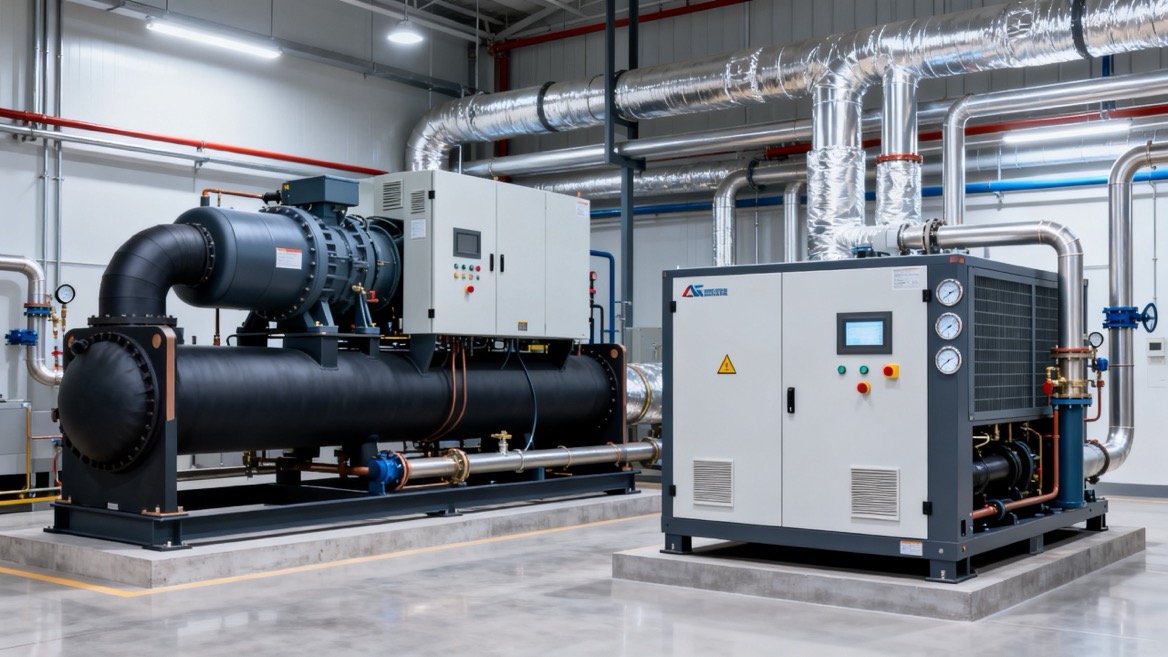
What Is a Screw Chiller?
A screw chiller uses one or more rotary screw compressors to compress refrigerant vapor and support the refrigeration cycle. Inside the compressor, paired helical rotors trap and compress refrigerant continuously as they rotate.
This design makes screw compressors particularly suitable for applications that require large cooling capacity, long operating hours, and relatively stable cooling demand.
In many industrial facilities, a screw chiller serves as the central cooling source for equipment such as:
– Plastic injection molding machines
– Extrusion lines
– CNC machining systems
– Chemical reactors
– Laser equipment
– Food and beverage processing lines
– Large cold rooms
– Pharmaceutical process systems
– Industrial water-cooling loops
– Agricultural climate-control systems
A screw chiller can be designed as an air-cooled screw chiller or a water-cooled screw chiller. Water-cooled configurations are often selected for large facilities with cooling towers and high annual operating hours, while air-cooled systems are often preferred where water availability, installation simplicity, or local operating conditions make cooling towers less practical.
The main technical advantage of a screw compressor is its ability to deliver continuous, high-volume refrigeration capacity. Inverter-driven screw chillers can also adjust compressor speed to follow changing process demand more smoothly.
What Is a Scroll Chiller?
A scroll chiller uses scroll compressors, which contain two spiral-shaped elements. One scroll remains stationary while the other moves in an orbital motion. Refrigerant vapor is drawn into the outer edge of the scroll set and gradually compressed toward the center.
Scroll compressors are widely used in compact commercial cooling systems, small industrial chillers, modular chiller systems, and applications where low vibration and simple maintenance are important.
A scroll chiller may contain one compressor or multiple compressors. Multi-scroll designs divide the total cooling demand among several smaller compressors, allowing the chiller to stage capacity as demand rises or falls.
This structure can offer practical benefits for facilities with fluctuating loads. Instead of operating one large compressor at a low load, the system can switch compressors on or off based on actual demand.
Typical scroll chiller applications include:
– Small and medium manufacturing workshops
– Laboratory cooling
– Medical equipment cooling
– Commercial buildings
– Small food-processing operations
– Small cold rooms
– Beverage equipment
– Printing and packaging equipment
– Precision instrument cooling
– Greenhouse and indoor-farming environmental control systems
Modern variable-speed scroll systems can improve load matching further. They can be especially useful where the cooling load changes significantly throughout the day or season.
Screw Chiller vs Scroll Chiller: Core Differences
The most important difference between screw and scroll chillers is not the refrigeration cycle itself. Both use vapor-compression refrigeration. The difference lies in the compressor architecture, which influences system capacity, operating behavior, maintenance needs, control flexibility, and cost.
| Comparison Factor | Screw Chiller | Scroll Chiller |
|---|---|---|
| Compressor design | Twin-rotor or single-screw compression | Orbiting spiral scroll compression |
| Typical project scale | Medium to large | Small to medium |
| Best operating profile | Long-duration, steady, high cooling load | Variable, intermittent, or modular cooling load |
| Capacity control | Stepless or near-stepless with slide valve and/or inverter | Compressor staging, digital scroll, or variable-speed control |
| Full-load performance | Often strong for continuous industrial operation | Effective within smaller capacity ranges |
| Part-load operation | Strong when equipped with optimized controls and variable speed | Often highly flexible in multi-compressor configurations |
| Redundancy | Depends on compressor quantity and system design | Often strong because multiple compressors can operate independently |
| Maintenance | Requires disciplined oil and compressor-system management | Generally simpler at smaller system scales |
| Initial investment | Often higher for large systems | Often lower for smaller applications |
| Expansion flexibility | Best planned at project-design stage | Modular systems are easier to add in stages |
| Typical applications | Process cooling, cold storage, manufacturing, large agricultural systems | Small process lines, labs, commercial cooling, modular projects |
Neither technology should be selected solely because it is “more efficient.” The correct question is: Which chiller can maintain the required water temperature with the lowest total operating risk and lifecycle cost?
Cooling Capacity and Continuous-Duty Performance
For stable process cooling, cooling capacity is often the first selection factor. A chiller must handle not only the average load but also the highest expected heat load during production peaks, high ambient temperatures, equipment start-up, or seasonal changes.
When Screw Chillers Have an Advantage
A screw chiller is generally a strong fit when a plant has a large cooling requirement and operates for extended periods. For example, a plastic extrusion line or food-processing facility may run two or three shifts per day. In this situation, the cooling load may remain close to the design point for many hours.
A properly selected screw chiller can provide:
– High cooling capacity from a compact central unit
– Stable operation under continuous process demand
– Smooth capacity adjustment with variable-speed controls
– Strong performance in large chilled-water loops
– Simplified central monitoring for multi-zone facilities
– A practical platform for industrial automation integration
A screw compressor’s continuous compression process is particularly valuable when the cooling system must avoid frequent stopping and restarting. In process industries, frequent cycling can create temperature swings, increase wear, and complicate production control.
For a large central cooling plant, using several screw chillers can also provide staged capacity and operational backup. Rather than using one oversized machine, engineers can use duty/standby or lead/lag configurations to protect production continuity.
When Scroll Chillers Have an Advantage
Scroll chillers are often attractive for systems with a smaller total load or a load profile that changes significantly throughout the day.
For example, a precision-testing laboratory may require only modest cooling during standby periods, then experience short cooling peaks when testing equipment starts. A multi-scroll chiller can activate only the number of compressors needed at a given time.
This can offer several benefits:
– Good load matching for fluctuating cooling demand
– Reduced energy waste during low-load periods
– Lower vibration and quieter operation
– Easier transport and installation for compact projects
– Faster deployment for modular facilities
– Partial capacity availability if one compressor requires service
For a smaller facility, installing a large screw chiller may create unnecessary capital cost and poor load matching. In that situation, a modular scroll chiller can be a more practical solution.
Temperature Stability: Which Chiller Is Better?
Temperature stability is one of the most important considerations in industrial process cooling. Even a small water-temperature fluctuation can affect product quality, cycle time, dimensional accuracy, chemical reaction performance, or equipment reliability.
The correct answer is not that one compressor type automatically produces better temperature stability. Temperature control depends on the complete system design, including the chiller, water tank, pump, piping, control algorithm, sensors, valves, and process load.
That said, the two chiller types respond differently to changing conditions.
Screw Chillers for Stable Base Loads
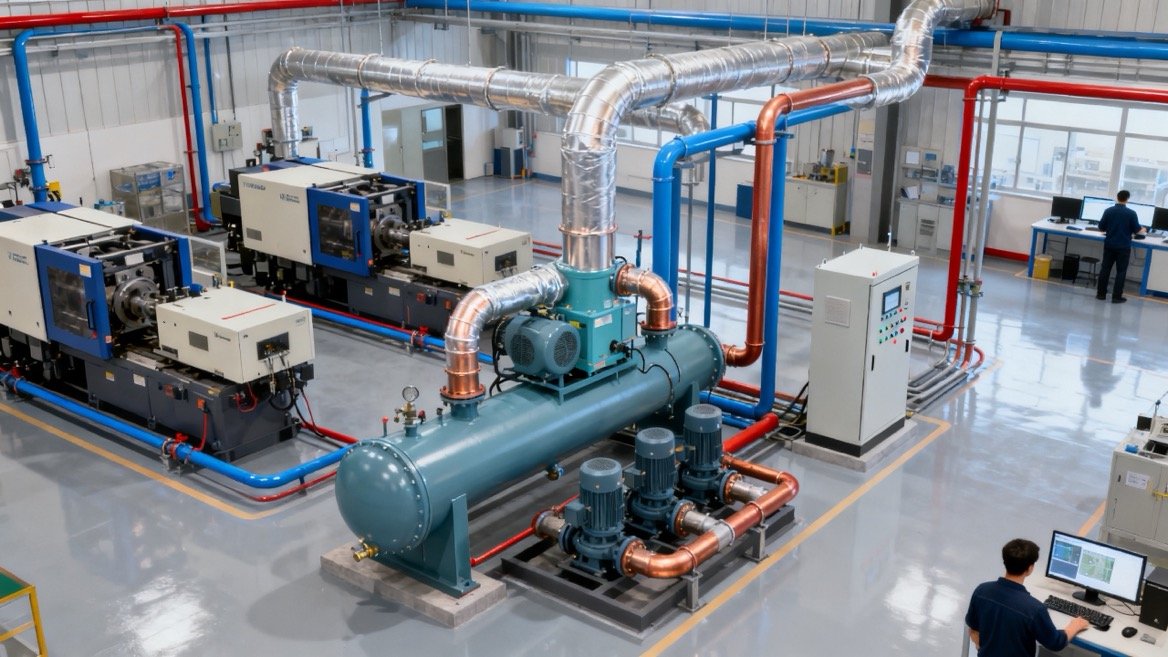
A screw chiller is usually well suited to a process with a consistent cooling requirement. When the cooling load remains relatively stable, the compressor can operate efficiently and maintain a steady chilled-water supply temperature.
For example, a factory operating multiple injection molding machines may require continuous 12°C process water. If the machines operate consistently throughout the shift, a screw chiller can maintain a stable central water loop with limited load disturbance.
A well-designed screw chiller system should include:
– Variable-speed compressor control where appropriate
– Stable chilled-water flow
– Adequate thermal storage volume
– Accurate supply- and return-water sensors
– Properly sized pumps
– Flow protection and low-flow alarms
– Control logic for staged equipment start-up
For large industrial loops, a buffer tank is particularly important. It adds water volume, reduces short cycling, and helps absorb sudden heat-load changes.
Scroll Chillers for Variable Loads
A scroll chiller can be highly effective when the cooling load changes in steps. Multi-scroll systems can stage compressors on and off as demand rises or falls.
For example, an agricultural indoor-growing facility may experience changes in cooling demand caused by lighting schedules, outside weather, humidity control, and plant growth stages. A multi-scroll system can respond by adding or removing compressor capacity in stages.
However, poor system design can still cause temperature instability. If the water volume is too low or the chiller capacity is oversized, the system may cycle frequently. Frequent cycling can lead to uneven supply-water temperatures and unnecessary energy consumption.
To improve stability in a scroll chiller system, engineers should consider:
– Multiple compressor stages
– Variable-speed pumps
– A properly sized buffer tank
– Tight supply-water temperature control
– Demand-based control logic
– Smooth communication with production equipment or environmental controllers
The best chiller for temperature stability is the one that can closely match the real cooling load without excessive cycling.
Energy Efficiency: Full Load Is Not Enough
Many chiller selection mistakes happen because buyers compare only rated capacity and full-load efficiency. In actual operations, many cooling systems do not stay at 100% load all day.
Cooling demand changes because of:
– Outdoor temperature variation
– Production schedules
– Seasonal conditions
– Shift changes
– Product changes
– Equipment start-up and shutdown
– Changes in raw-material temperature
– Varying process-water return temperatures
For this reason, facilities should evaluate both full-load performance and part-load performance.
A lower condenser-water temperature can materially improve chiller performance. Energy-efficiency guidance notes that, in many situations, reducing water-cooled condenser-water temperature by 1°F can improve compressor efficiency by approximately 1% to 2%. This highlights why cooling tower performance, condenser cleanliness, and water-flow management are just as important as compressor selection.
Screw Chiller Efficiency
Screw chillers are often effective in large systems that operate steadily near their design load. Modern units with variable-speed drives, electronic expansion valves, optimized heat exchangers, and intelligent unloading strategies can improve performance across a broader operating range.
However, traditional slide-valve unloading may reduce compressor efficiency at low loads if it is not paired with a well-designed variable-speed strategy. Therefore, buyers should ask for performance data across expected operating conditions rather than accepting one rated figure.
For screw chiller projects, request data at:
– 100% load
– 75% load
– 50% load
– 25% load
– Expected entering condenser conditions
– Actual chilled-water supply temperature
– Expected process-water return temperature
Scroll Chiller Efficiency
Scroll chillers can offer strong energy performance in smaller systems, especially when several compressors allow capacity to be staged. When demand decreases, the system can turn off unnecessary compressors rather than operating a large compressor inefficiently at a very low capacity.
Research on air-cooled packaged water chillers has specifically examined the part-load behavior of inverter-driven scroll compressors, reinforcing the importance of evaluating performance beyond rated full-load conditions.
Variable-speed scroll compressors can provide even finer load matching. However, performance still depends on the refrigerant circuit, condenser design, ambient temperature, control logic, and actual operating hours.
A Practical Efficiency Rule
Use this simple selection principle:
– Choose a screw chiller when the facility has a large, sustained, relatively predictable cooling load.
– Choose a scroll chiller when cooling demand is smaller, more variable, or best served by multiple staged compressors.
– Choose a multi-unit system when production continuity is more important than minimizing the number of machines.
The annual electricity bill is determined by how the chiller operates during thousands of real hours—not by a single catalog value.
Reliability, Redundancy, and Production Risk
In many industrial and agricultural projects, refrigeration failure is not only an equipment problem. It can become a production-loss problem.
A sudden rise in process-water temperature can cause:
– Product defects
– Mold cycle delays
– Equipment alarms
– Material degradation
– Inconsistent viscosity or curing
– Food-safety risks
– Crop stress in controlled agriculture
– Cold-chain temperature excursions
Screw Chiller Reliability Considerations
Screw compressors are widely used in demanding industrial conditions because they can provide reliable continuous-duty operation when properly applied and maintained.
However, screw chiller reliability depends on disciplined system management. The compressor and refrigeration circuit require attention to oil condition, oil return, refrigerant charge, vibration, suction and discharge pressure, condenser cleanliness, and water quality.
For a critical process, do not rely on a single large chiller without backup planning. A better design may include two or more chillers operating in lead/lag sequence.
For example, instead of one 600 kW screw chiller, a facility may consider:
1. Two 350 kW screw chillers.
2. One unit operating as the lead machine.
3. The second unit sharing peak load.
4. Automatic rotation to balance operating hours.
5. Partial cooling capacity remaining if one unit is offline.
This design may increase initial investment, but it can reduce the financial risk of a complete production shutdown.
Scroll Chiller Reliability Considerations
Multi-scroll chillers have a natural redundancy advantage. If one scroll compressor stops because of a fault or maintenance requirement, the remaining compressors may still provide partial cooling capacity.
This is useful for applications where partial operation is better than no operation at all.
For instance, a modular scroll chiller with four compressors may continue operating at 75% of nominal capacity if one compressor is unavailable. Whether that remaining capacity is sufficient depends on the actual process load and the system’s safety margin.
Scroll compressors also have fewer moving parts than many larger compressor designs, and their compact sealed construction can simplify maintenance at smaller capacities. Still, compressor staging, electrical components, sensors, water pumps, fans, and heat exchangers remain critical to system reliability.
Maintenance Requirements and Lifecycle Cost
The initial purchase price should never be the only cost considered. A chiller may operate for many years, and its electricity, maintenance, water treatment, downtime risk, and spare-parts needs can exceed the initial equipment cost.
Screw Chiller Maintenance
A screw chiller typically requires a more structured maintenance program, especially in large industrial systems.
Maintenance priorities include:
– Checking oil level and oil quality
– Monitoring oil filters and separators
– Inspecting refrigerant pressures and temperatures
– Cleaning condenser surfaces
– Maintaining cooling-water quality in water-cooled systems
– Testing sensors, safeties, and control functions
– Inspecting electrical terminals and inverter components
– Reviewing operating trends for early fault detection
A water-cooled screw chiller may achieve strong operating efficiency, but it also requires cooling-tower maintenance, water treatment, and condenser-tube cleaning. These requirements should be included in the lifecycle-cost analysis.
Scroll Chiller Maintenance
Scroll chillers are often easier to maintain in smaller facilities because individual compressors are compact and modular. A technician may be able to isolate and service one compressor while the remaining compressors continue operating.
Typical maintenance work includes:
– Cleaning air-cooled condenser coils
– Checking fan operation
– Inspecting electrical controls
– Verifying refrigerant charge
– Checking water flow and pump performance
– Cleaning filters and strainers
– Testing temperature and pressure sensors
For air-cooled systems, coil cleanliness is especially important. Dust, oil, agricultural debris, and poor ventilation can raise condensing temperature and reduce cooling capacity.
A neglected condenser can make either a screw chiller or a scroll chiller consume more energy and deliver less cooling.
How to Select the Right Chiller
The best way to choose between a screw chiller and a scroll chiller is to start with the process—not the compressor.
Use the following evaluation process before requesting quotations.
Step 1: Define the Actual Cooling Load
Identify:
– Required cooling capacity in kW, RT, or kcal/h
– Required water supply temperature
– Expected water return temperature
– Water flow rate
– Maximum ambient temperature
– Operating hours per day
– Annual operating days
– Peak production condition
– Required temperature-control accuracy
A cooling system should be sized using measured or carefully calculated heat load whenever possible. Avoid choosing capacity only according to the total electrical rating of connected equipment.
Step 2: Understand the Load Profile
Ask whether the load is:
– Constant for long periods
– Highly variable
– Seasonal
– Batch-based
– Growing over time
– Sensitive to short temperature fluctuations
– Critical enough to require backup capacity
A facility with a stable 24-hour process profile will often favor a screw chiller. A facility with changing loads, independent zones, or future expansion may favor a modular scroll solution.
Step 3: Evaluate Installation Conditions
Consider:
– Available installation space
– Indoor or outdoor location
– Noise restrictions
– Water availability
– Cooling-tower feasibility
– Local climate
– Electrical capacity
– Water quality
– Service access
– Future expansion space
An air-cooled scroll chiller can be a fast and practical solution for a smaller facility. A water-cooled screw chiller may be more appropriate for a larger plant with a machine room, cooling tower, and professional maintenance team.
Step 4: Compare Annual Operating Cost
Request performance data based on actual operating conditions. Do not compare different chillers only at standard rating conditions.
Ask the supplier to provide:
– Capacity at design conditions
– Input power at design conditions
– Part-load operating data
– Compressor-control method
– Pump configuration
– Heat-exchanger details
– Expected annual energy estimate
– Recommended maintenance plan
– Spare-parts availability
– Warranty coverage
Step 5: Plan for Failure Scenarios
Ask one essential question: What happens if one compressor or one chiller is unavailable?
For critical processes, consider:
– N+1 chiller capacity
– Multiple compressor circuits
– Backup pumps
– Automatic lead/lag control
– Remote alarms
– Emergency power planning
– Buffer-tank reserve
– Preventive maintenance scheduling
The best cooling system is not merely efficient under ideal conditions. It should also protect the process when conditions are not ideal.
Screw Chiller vs Scroll Chiller: Best Applications
| Application | Recommended Technology | Why |
|---|---|---|
| Large plastic injection molding plant | Screw chiller | Strong continuous-duty capacity and central process-water control |
| Large food-processing factory | Screw chiller or multiple screw chillers | Suitable for long operating hours and substantial cooling demand |
| Medium cold-storage warehouse | Screw chiller | Effective for sustained refrigeration loads and centralized monitoring |
| Small workshop with several machines | Scroll chiller | Compact, practical, and easier to match to smaller demand |
| Laboratory or testing facility | Multi-scroll chiller | Good staged control and partial-capacity redundancy |
| Greenhouse or vertical farm | Scroll or screw, depending on scale | Scroll suits smaller variable zones; screw fits large continuous environmental loads |
| Printing and packaging line | Scroll or screw, based on duty cycle | Scroll for smaller intermittent loads; screw for continuous high-speed production |
| Multi-phase factory expansion | Modular scroll chiller | Easier staged installation and capacity expansion |
| Large industrial water loop | Screw chiller | Better fit for higher capacity and centralized process cooling
|

Final Verdict: Which Technology Is Better?
For stable process cooling in large, continuous, high-demand operations, a screw chiller is usually the better technology. It is particularly suitable for industrial manufacturing, large food-processing facilities, central chilled-water systems, cold-chain applications, and large agricultural environmental-control projects.
For small-to-medium cooling loads with variable demand, a scroll chiller can be the better choice. Its modular design, staged compressor operation, compact footprint, and partial-capacity backup make it highly practical for smaller facilities and phased expansions.
The best decision depends on five project-specific questions:
1. How much cooling capacity is required at peak load?
2. How stable or variable is the cooling load throughout the day?
3. How important is uninterrupted operation?
4. What are the available installation and maintenance resources?
5. What is the total lifecycle cost over the expected operating period?
At Zhejiang Kingfit Environment Co., Ltd., we recommend selecting chillers based on the complete operating environment: process temperature, load profile, climate, water conditions, production schedule, energy target, and future expansion plan. A properly engineered cooling system can deliver stable process water, lower operating risk, and more predictable long-term performance.
Need a stable cooling solution for your process, cold storage, food line, or agricultural environment? Contact Zhejiang Kingfit Environment Co., Ltd. with your required cooling capacity, supply-water temperature, return-water temperature, ambient conditions, and operating hours. Our engineering team can help evaluate whether a screw chiller, scroll chiller, or multi-unit configuration is the right fit for your application.
FAQ
1. Is a screw chiller more efficient than a scroll chiller?
Not always. A screw chiller can be highly effective for large and continuous cooling loads, especially when the system operates near its design capacity for long periods. A scroll chiller can perform very well at smaller capacities and changing loads, particularly when multiple compressors or variable-speed controls improve load matching.
2. Which chiller is better for a plastic injection molding factory?
A screw chiller is often preferred for a medium-to-large plastic injection molding factory because it can provide stable process-water cooling during long production shifts. However, a smaller workshop with only a few molding machines may benefit more from a scroll chiller or modular chiller system.
3. Are scroll chillers good for industrial applications?
Yes. Scroll chillers are suitable for many industrial applications, including small machine cooling, laser equipment, laboratory systems, printing equipment, packaging lines, and compact process-cooling loops. The key limitation is that they are generally more appropriate for small-to-medium capacity ranges.
4. Can a screw chiller operate efficiently at part load?
Yes, especially when it uses modern variable-speed control and optimized capacity-management technology. Buyers should request performance data at multiple load points because real facilities rarely operate at full load all the time.
5. Which chiller provides better redundancy?
A multi-scroll chiller often provides strong built-in redundancy because it uses several compressors. If one compressor stops, the system may still deliver partial cooling capacity. Screw chiller systems can also provide excellent redundancy when multiple units are installed in a lead/lag or N+1 arrangement.
6. Should I choose an air-cooled or water-cooled chiller?
The answer depends on project conditions. Air-cooled chillers are simpler to install and do not require cooling towers. Water-cooled chillers can be a stronger choice for large facilities with high operating hours, sufficient water-treatment capability, and space for cooling-tower equipment.
7. How can I improve chiller temperature stability?
Use a correctly sized chiller, adequate buffer-tank volume, stable water flow, accurate sensors, properly sized pumps, clean heat exchangers, and a control system that matches capacity to the real process load. Avoid excessive oversizing, because it can cause short cycling and temperature fluctuations.
References
1. [ASHRAE — Fundamentals of Refrigeration]
2. [North Carolina Department of Environmental Quality — Energy Saving Fact Sheet: Chillers]
4. [Atlas Copco — A Complete Guide to Scroll Compressors]
6. [Commercial Energy Library — Screw Compressor Performance]
Hot Tags: Screw Chiller, Scroll Chiller, Industrial Process Cooling, Air Cooled Screw Chiller, Water Cooled Screw Chiller, Air Cooled Scroll Chiller, Industrial Water Chiller, Process Cooling System, Industrial Refrigeration Equipment, Chiller Compressor Types