


Content Menu
● What Does a Chiller Compressor Do?
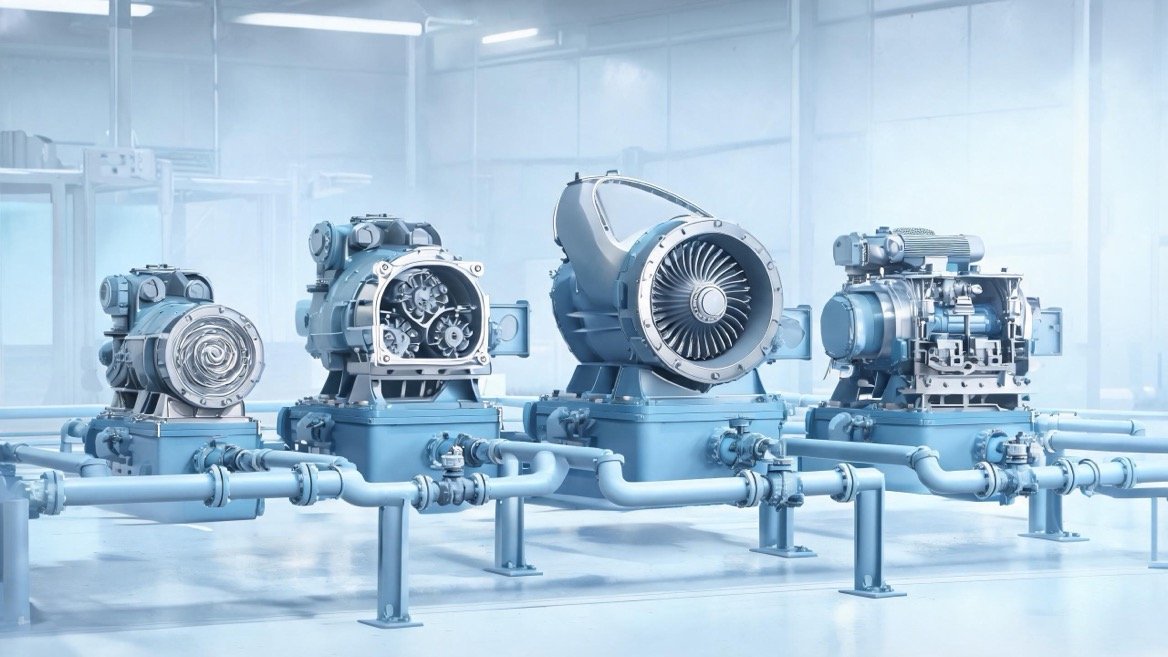
● The Four Main Types of Chiller Compressors
>> Scroll Compressors: Compact and Efficient for Small to Medium Loads
>> Key advantages of scroll compressors
● Screw Compressors: Reliable Capacity for Industrial Process Cooling
>> Why screw compressors remain a leading industrial choice
>> Important design considerations
● Centrifugal Compressors: High Efficiency for Large Central Cooling Plants
>> Key strengths of centrifugal compressors
>> What engineers should assess carefully
● Reciprocating Compressors: A Proven Option for Specific Applications
● Chiller Compressor Comparison Table
● How to Choose a Chiller Compressor
>> 1. Calculate the actual cooling load
>> 2. Focus on part-load operation
>> 3. Consider the cooling medium and environment
>> 4. Evaluate lifecycle cost, not only purchase price
● Practical Example: Selecting for a Food Processing Plant
● Maintenance Practices That Protect Compressor Life
● Work With a Chiller System Partner
● FAQ
>> Which chiller compressor type is the most energy efficient?
>> Are screw compressors better than scroll compressors?
>> Can one chiller use multiple compressors?
>> What is IPLV in chiller selection?
>> Does a variable-speed drive reduce chiller energy use?
>> What causes chiller compressor failure?
>> How often should an industrial chiller compressor be maintained?
Choosing the right chiller compressor type is one of the most important decisions in an industrial or agricultural cooling project. The compressor determines how reliably a chiller responds to changing loads, how much electricity it consumes, how much space it needs, and how easily it can be maintained over its service life.
At Zhejiang Kingfit Environment Co., Ltd., we approach compressor selection as a system-design decision—not simply a component choice. A food-processing line, plastic injection workshop, greenhouse, cold-storage room, and process-cooling plant may all need chilled water, but their operating profiles, temperature requirements, seasonal demand, and downtime tolerance can be very different.
This guide explains the four main types of chiller compressors—scroll, screw, centrifugal, and reciprocating—and provides a practical framework for selecting the best solution for your cooling application.
What Does a Chiller Compressor Do?
A chiller compressor is the driving force of the vapor-compression refrigeration cycle. It draws low-pressure refrigerant vapor from the evaporator, compresses it into a higher-pressure and higher-temperature vapor, and sends it to the condenser for heat rejection.
Without stable compression, a chiller cannot continuously transfer heat away from process water, glycol solution, air-handling coils, storage areas, or agricultural environments.
In practical terms, the compressor affects:
– Cooling capacity and temperature stability
– Energy use at full load and partial load
– Noise and vibration in the installation area
– Maintenance workload and service accessibility
– Initial investment and long-term operating cost
– Response to fluctuating process demand
– System redundancy when multiple compressors are installed
A correct selection begins with real operating conditions rather than a nominal cooling-capacity number alone.
The Four Main Types of Chiller Compressors
Scroll Compressors: Compact and Efficient for Small to Medium Loads
A scroll compressor uses two spiral-shaped scrolls. One scroll remains fixed while the other moves in an orbiting motion. Refrigerant enters around the outside of the scroll set, becomes trapped in gradually smaller pockets, and is compressed toward the center before discharge.
Because the compression process is continuous and the mechanical design is relatively simple, scroll compressors are widely used in compact air-cooled chillers, modular chillers, small process chillers, and precision temperature-control systems.
Best suited for:
– Small and medium industrial chillers
– Greenhouses and agricultural environmental control
– Laboratories and testing equipment
– Small food-processing lines
– Commercial buildings and comfort cooling
– Applications requiring multiple staged compressors
Key advantages of scroll compressors
– Compact footprint: Scroll compressors help manufacturers build smaller chiller packages where installation space is limited.
– Low vibration: Their smooth compression cycle supports quieter operation than many piston-based alternatives.
– Strong part-load flexibility: Multiple scroll compressors can be staged on and off to better match changing cooling demand.
– Simple system design: Their compact construction can simplify equipment layout and routine service.
– Good efficiency at smaller capacities: They are often a practical choice where a large screw or centrifugal machine would be oversized.
Limitations to consider
Scroll compressors have a narrower practical capacity range than large screw or centrifugal machines. They are not usually the first choice for very high-load central cooling plants. They can also be sensitive to liquid refrigerant returning to the compressor, so proper refrigerant charge, superheat control, and suction-line design are essential.
Screw Compressors: Reliable Capacity for Industrial Process Cooling
A screw compressor uses two intermeshing helical rotors. As the rotors turn, refrigerant vapor enters the spaces between the rotors and casing. The trapped gas volume becomes smaller as it moves along the rotor length, increasing pressure before discharge.
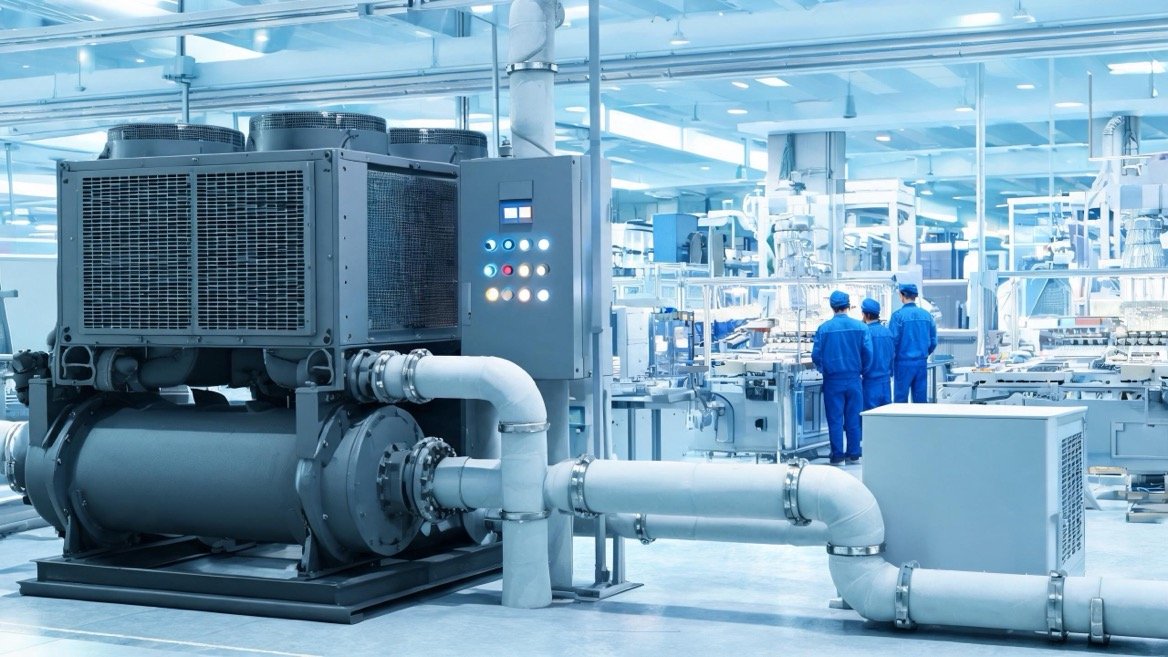
Screw compressor chillers are widely used for medium to large industrial cooling loads because they offer stable operation, broad capacity coverage, and good tolerance for demanding operating environments.
Best suited for:
– Plastic extrusion and injection molding
– Chemical and pharmaceutical process cooling
– Food and beverage production
– Cold-chain logistics and cold storage
– Industrial manufacturing plants
– Large agricultural packing and post-harvest cooling
– Continuous-duty production lines
Why screw compressors remain a leading industrial choice
– Stable continuous operation: Screw compressors are well suited to facilities that need cooling around the clock.
– High cooling capacity: They can support much larger loads than typical scroll-based systems.
– Flexible control options: Slide valves, variable-speed drives, and multiple-compressor configurations can help match actual cooling demand.
– Robust construction: Their design supports demanding industrial environments when lubrication and oil management are properly maintained.
– Wide operating range: They can perform effectively in many process-cooling applications with changing condensing and evaporating conditions.
Important design considerations
Most screw compressors depend on an oil-management system. This means oil separators, oil filters, oil cooling, and regular monitoring are important parts of reliable operation. A screw chiller should not be selected only because it has a higher nominal capacity; its efficiency at the facility’s most common load condition is equally important.
For a factory that operates at 40–70% load for much of the year, selecting a variable-speed screw chiller or a multi-compressor system may reduce unnecessary energy use compared with a fixed-capacity design.
Centrifugal Compressors: High Efficiency for Large Central Cooling Plants
A centrifugal compressor compresses refrigerant through high-speed rotating impellers. The impeller accelerates refrigerant vapor, while diffuser components convert velocity into pressure. Unlike scroll, screw, and reciprocating compressors, centrifugal compressors are dynamic rather than positive-displacement machines.
They are generally used in large water-cooled chiller plants, district cooling systems, large production campuses, high-capacity commercial buildings, and major industrial facilities.
Best suited for:
– Large industrial campuses
– Central chilled-water plants
– Large food-processing facilities
– Data centers and high-load infrastructure
– Large commercial buildings
– District cooling projects
– Facilities with relatively stable, high cooling demand
Key strengths of centrifugal compressors
– Excellent performance at large capacity: Centrifugal technology can deliver very high cooling output in a centralized design.
– Fewer wearing contact components: Depending on the design, this can reduce some mechanical wear points.
– Potential for oil-free operation: Magnetic-bearing centrifugal compressors can operate without conventional lubrication oil in the refrigerant circuit.
– Low vibration: Properly designed centrifugal machines can operate smoothly, which benefits sensitive installations.
– Strong part-load potential with variable speed: Variable-speed magnetic-bearing systems can perform especially well where cooling loads are below peak for much of the year. A U.S. Department of Energy case study reported 42% energy savings for a magnetic-bearing chiller project, largely because the equipment operated frequently at part-load conditions.
What engineers should assess carefully
Centrifugal compressors are highly application-dependent. Their performance can be affected by system pressure lift, condenser-water temperature, load variation, and control strategy. They may not be the best solution for smaller sites or projects with sharply fluctuating loads unless the system is carefully engineered.
A centrifugal compressor can also experience unstable operating conditions such as surge when it operates outside a suitable flow range. Proper capacity control, stable water flow, accurate sensors, and coordinated controls are essential.
Reciprocating Compressors: A Proven Option for Specific Applications
A reciprocating compressor uses pistons moving inside cylinders. As a piston moves downward, it draws refrigerant vapor into the cylinder. As it moves upward, it compresses the vapor and discharges it at higher pressure.
This is one of the oldest compressor technologies in refrigeration. Although newer technologies have replaced reciprocating compressors in many large chiller applications, they remain useful in selected low- to medium-capacity systems and in applications that require higher pressure ratios.
Best suited for:
– Smaller industrial refrigeration systems
– Certain low-temperature applications
– Retrofit projects
– Applications with significant pressure variation
– Equipment where service familiarity is a priority
Advantages and trade-offs
Reciprocating compressors can provide good compression performance across a wide pressure range. Their individual cylinders may also offer useful capacity-control possibilities in some designs.
However, they usually have more moving parts than scroll or screw compressors. This can mean higher vibration, more noise, and more frequent maintenance requirements. For projects where low noise, compact dimensions, and minimal maintenance are priorities, scroll or screw technology is often more appropriate.
Chiller Compressor Comparison Table
| Compressor Type | Typical Project Scale | Main Strength | Main Limitation | Best Application |
|---|---|---|---|---|
| Scroll | Small to medium | Compact, quiet, flexible staging | Limited for very large loads | Modular chillers, small process cooling, greenhouses |
| Screw | Medium to large | Reliable continuous industrial cooling | Requires disciplined oil management | Manufacturing, food processing, cold storage |
| Centrifugal | Large to very large | High-capacity central cooling and strong part-load potential | Requires careful system matching | Central plants, large facilities, district cooling |
| Reciprocating | Small to medium | Broad pressure capability and established service methods | More vibration and maintenance | Specialized refrigeration and retrofit projects |
How to Choose a Chiller Compressor
The best compressor is the one that matches your real operating profile. Before selecting a chiller, evaluate the following factors with the equipment supplier and project engineer.
1. Calculate the actual cooling load
Do not choose equipment based only on the highest possible demand. Review:
– Peak heat load from equipment or process
– Required chilled-water supply and return temperatures
– Seasonal ambient temperature
– Production schedule and operating hours
– Future expansion plans
– Safety margin for process changes
An oversized chiller may cycle excessively and operate inefficiently. An undersized unit may fail to maintain temperature during critical production periods.
2. Focus on part-load operation
Most chillers do not run at full load all day, every day. This is why part-load performance deserves close attention. Integrated Part Load Value and Non-Standard Part Load Value are commonly used performance metrics for comparing chiller efficiency across different operating conditions. AHRI certification programs verify ratings such as capacity, energy efficiency, IPLV, and NPLV under standardized test methods.
For a facility with frequent production changes, seasonal variation, or multiple cooling zones, consider:
– Variable-speed compressor control
– Multiple compressors with staged operation
– Modular chiller configurations
– Independent cooling loops for different temperature requirements
3. Consider the cooling medium and environment
Air-cooled and water-cooled chillers create different selection conditions.
– Air-cooled chillers are often simpler to install because they do not require a cooling tower. They are common where water availability, installation speed, or maintenance simplicity matters.
– Water-cooled chillers can offer strong efficiency potential in larger installations but require a cooling tower, water treatment, pumps, and ongoing water-system management.
– Glycol systems may be required for low-temperature processes, freeze protection, or agricultural applications exposed to cold ambient conditions.
4. Evaluate lifecycle cost, not only purchase price
The initial equipment price is important, but electricity, downtime, water treatment, spare parts, and service labor can represent a much larger cost over the life of the system.
For air-cooled electric chillers, public procurement guidance distinguishes between equipment optimized for full-load operation and equipment optimized for part-load performance, reinforcing the need to match the efficiency target to the expected operating profile.
A lower-cost compressor choice may become expensive if it operates inefficiently for thousands of hours each year.
Practical Example: Selecting for a Food Processing Plant
Consider a food-processing facility that needs chilled water for product cooling, packaging equipment, and a temperature-controlled production area. Its production volume increases during the summer and changes between day and night shifts.
A single fixed-capacity compressor may perform adequately at peak demand but waste energy during lower-load periods. A more suitable configuration may include:
1. A screw chiller designed for the main process load.
2. Variable-speed control to adapt output to changing production demand.
3. A buffer tank to reduce short cycling and improve temperature stability.
4. Separate control zones for process cooling and room cooling.
5. Remote monitoring for supply temperature, return temperature, compressor load, alarms, and power consumption.
For smaller facilities, a multi-scroll chiller may offer similar load-staging benefits with a more compact layout.
Maintenance Practices That Protect Compressor Life
Even the right compressor will not deliver reliable performance without correct installation and maintenance. A preventive maintenance plan should include:
– Checking refrigerant charge and leak indications
– Monitoring suction and discharge pressures
– Confirming superheat and subcooling values
– Cleaning condenser coils or maintaining cooling-water quality
– Inspecting electrical terminals, contactors, and variable-speed drives
– Replacing oil filters and checking oil condition where applicable
– Verifying water flow, pump operation, and filter cleanliness
– Reviewing alarm history and operating trends
– Confirming vibration and noise remain within normal limits
Early warning signs include rising power consumption, unstable chilled-water temperature, repeated high-pressure alarms, unusual vibration, compressor noise, frequent starts, or reduced cooling capacity. Addressing these signals early can prevent a minor performance problem from becoming a costly shutdown.

Work With a Chiller System Partner
Compressor selection should support your complete cooling objective: stable temperature, lower operating cost, dependable production, and room for future growth. Zhejiang Kingfit Environment Co., Ltd. provides industrial refrigeration and intelligent agricultural environmental-control solutions tailored to the needs of manufacturing, food processing, cold-chain storage, agriculture, and other temperature-sensitive sectors.
Whether you need a compact air-cooled chiller, an industrial screw chiller, a low-temperature glycol system, or a customized integrated cooling solution, our technical team can help evaluate your cooling load, operating conditions, control needs, and energy objectives.
Contact Zhejiang Kingfit today to discuss your project and receive a tailored chiller selection proposal.
FAQ
Which chiller compressor type is the most energy efficient?
There is no single answer for every project. Centrifugal compressors can provide very strong efficiency in large central systems, especially when paired with variable-speed and magnetic-bearing technology. Scroll compressors can be highly effective in small systems, while screw compressors are often a dependable choice for medium and large industrial loads. The most efficient option depends on capacity, load profile, ambient conditions, and system design.
Are screw compressors better than scroll compressors?
Screw compressors are generally better suited to larger, continuous industrial cooling loads. Scroll compressors are usually more compact and practical for smaller systems. A multi-scroll configuration can also offer excellent staged capacity control in applications with changing demand.
Can one chiller use multiple compressors?
Yes. Multiple-compressor systems can improve capacity control and provide a degree of operational redundancy. If one compressor is unavailable, the remaining compressors may continue providing partial cooling capacity, depending on the system design.
What is IPLV in chiller selection?
IPLV is a standardized part-load efficiency metric that evaluates a chiller at several load points rather than only at maximum capacity. It helps buyers compare expected performance when a chiller operates below full load, which is common in real facilities.
Does a variable-speed drive reduce chiller energy use?
Often, yes. Variable-speed control allows a compressor to better match cooling output to actual demand. This can be especially valuable in applications with changing production loads, seasonal temperature variation, or frequent low-load operation.
What causes chiller compressor failure?
Common causes include refrigerant leakage, liquid refrigerant return, poor oil management, high condensing pressure, blocked airflow or water flow, electrical faults, contaminated water systems, and inadequate maintenance. Correct commissioning and ongoing monitoring significantly reduce these risks.
How often should an industrial chiller compressor be maintained?
Maintenance frequency depends on the compressor type, operating hours, environment, refrigerant system design, and manufacturer requirements. Many facilities conduct routine visual and operating checks monthly, more detailed inspections quarterly, and comprehensive preventive maintenance annually.
References
– [ChillerOne — Different Types of Chiller Compressor]
– [U.S. Department of Energy — Purchasing Energy-Efficient Air-Cooled Electric Chillers]
– [U.S. Department of Energy — Magnetic-Bearing Chiller Compressors]
– [U.S. General Services Administration — Variable-Speed Magnetic Bearing Chiller Findings]
– [AHRI — Air-Cooled Water-Chilling Packages Using the Vapor Compression Cycle]
– [Natural Resources Canada — Chiller Energy Efficiency Requirements]
Hot Tags: Industrial Chiller, Chiller Compressor, Screw Chiller, Scroll Chiller, Centrifugal Chiller, Industrial Process Chiller, Air Cooled Chiller, Water Cooled Chiller, Industrial Cooling System, Chiller Manufacturer