


Content Menu
>> 1) Zhejiang Kingfit Environment Co., Ltd.
>> 2) Hangzhou Dahe Thermomagnetic Electronics Co., Ltd.
>> 3) Jiangsu Kangshijie Machinery Equipment Co., Ltd.
>> 4) Shanghai HanLeng Air Conditioning Refrigeration Equipment Co., Ltd.
>> 5) Suzhou Jimino Instrument Co., Ltd.
>> 6) Nanjing Ounuo Intelligent Equipment Co., Ltd.
>> 7) Nanjing Yiyang Technology Co., Ltd.
>> 8) Shandong Zhongcheng Testing Equipment Co., Ltd.
>> 9) Guangzhou Weilangshi Environmental Protection Equipment Co., Ltd.
>> 10) Dongguan Yiyun Refrigeration Technology Co., Ltd.
● FAQ
>> 1. How do I verify whether an ISO certificate is expired?
>> 2. How can I tell whether a factory is a real manufacturer or a trading company?
>> 3. What certifications should a magnetic chiller supplier usually provide?
>> 4. Why is MOQ not enough to judge a supplier?
>> 5. What is the safest sample approval process?
China remains one of the most practical sourcing bases for magnetic chiller buyers because it combines mature industrial clusters, strong export capacity, and broad OEM/ODM support across industrial cooling categories. For procurement teams, the real value is not just price, but whether a supplier can prove factory capability, stable QC, compliant documentation, and repeatable delivery.
How We Selected Suppliers
This list was built for buyers who need long-term partners, not one-off quotes. The screening logic focused on four buyer-facing checks: legal manufacturing identity, production capacity, certification validity, and comparable export/service experience.
The most useful suppliers for international buyers usually have three traits: clear factory ownership or control, written QC flow from incoming inspection to final inspection, and product scopes that match the target application. We also prioritized suppliers that can support OEM/ODM communication, because customization and documentation often matter as much as the machine itself.
Why China Matters
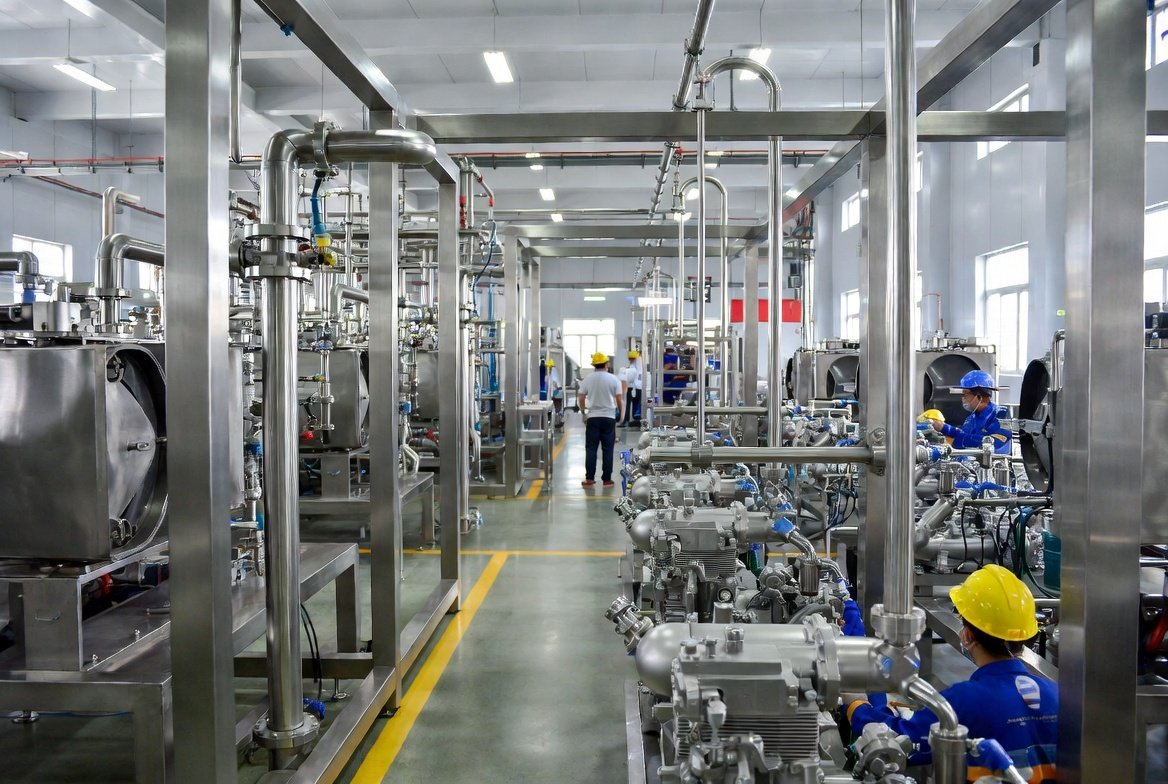
China’s cooling-equipment supply chain benefits from clustered manufacturing in coastal provinces such as Zhejiang, Jiangsu, Shanghai, Guangdong, and Shandong, where parts sourcing, machining, assembly, and export services are easier to coordinate. That cluster effect matters for buyers because it usually shortens lead times and makes technical communication more efficient.
The broader market backdrop is also favorable: magnetic refrigeration demand is projected to expand rapidly over the coming years as energy-efficient and lower-emission cooling technologies gain more attention. For buyers, that means supplier selection should emphasize capability and compliance rather than chasing the lowest quoted price.
Top 10 List
1) Zhejiang Kingfit Environment Co., Ltd.
Kingfit is a strong representative of a flexible, R&D-oriented Chinese factory for buyers seeking OEM support and responsive communication. The company was founded in 1998, has expanded to about 110,000 square meters, reports an annual production capacity of RMB 2 billion, and serves customers in more than 85 countries.
Its positioning is especially relevant for medium and small brands that need tailored solutions, faster coordination, and practical engineering support rather than rigid catalog supply. Kingfit also highlights extensive in-house development, many patents, and 100% testing before shipment, which are useful signals for buyers evaluating technical consistency.
2) Hangzhou Dahe Thermomagnetic Electronics Co., Ltd.
Hangzhou Dahe stands out for its longer operating history, having been established in 1992, which usually suggests deeper process maturity and accumulated engineering experience. Its business scope and product range cover industrial water chillers and related equipment, which is useful for buyers who want a supplier with broader cooling-system capabilities.
For procurement teams, this kind of supplier is often attractive when project stability and engineering depth matter more than rapid customization. Buyers should still verify the exact certification scope and current factory capacity before moving to sample approval.
3) Jiangsu Kangshijie Machinery Equipment Co., Ltd.
Kangshijie was established in 2009 and shows a relatively strong registered capital base in the source list, which may indicate stronger operational scale compared with newer workshops. Its business scope covers chillers, refrigeration equipment, central air conditioning, mold warmers, installation, maintenance, and repair.
That mix is useful for buyers who need both equipment supply and after-sales service coverage. It is a practical option when your sourcing project requires a supplier that can support multiple product lines and a more service-heavy commercial relationship.
4) Shanghai HanLeng Air Conditioning Refrigeration Equipment Co., Ltd.
Shanghai HanLeng was established in 2018 and is positioned around refrigeration and air-conditioning equipment, including air-cooled chiller and screw chiller units. Shanghai-based suppliers often benefit from strong logistics access, export familiarity, and easier international business coordination.
This type of supplier can work well for buyers who value straightforward commercial communication and a broader industrial equipment background. As always, the buyer should verify whether the factory itself manufactures the core system or relies on outsourced sub-assemblies.
5) Suzhou Jimino Instrument Co., Ltd.
Suzhou Jimino, established in 2014, is useful for buyers needing temperature-control equipment with an instrumentation-oriented background. Its product scope includes chillers, low-temperature constant-temperature circulating baths, and cooling-water circulation devices.
This can be a good fit for laboratory-adjacent, precision, or small-batch applications where product consistency matters. Buyers should check whether the supplier’s production system is optimized for standard industrial volume or for more specialized equipment.
6) Nanjing Ounuo Intelligent Equipment Co., Ltd.
Nanjing Ounuo was established in 2020 and presents a more automation- and equipment-development-oriented profile. Its scope includes refrigeration and air-conditioning equipment manufacturing, industrial automation system devices, and mechanical equipment R&D.
For buyers, this matters if the project needs non-standard controls, integrated systems, or custom engineering collaboration. The trade-off is that newer companies should be checked more carefully for production history, in-service references, and delivery consistency.
7) Nanjing Yiyang Technology Co., Ltd.
Nanjing Yiyang was established in 2021 and appears to serve buyers needing refrigeration equipment with related industrial machinery support. Its listed scope includes chillers, electric heating oil boilers, and high-low temperature integrated machines.
This makes it relevant for mixed-scenario applications where temperature control is only one part of the system. Because it is relatively young, buyers should pay extra attention to sample performance, spare-parts planning, and the factory’s actual QC discipline.
8) Shandong Zhongcheng Testing Equipment Co., Ltd.
Shandong Zhongcheng is especially relevant for test-equipment and environmental simulation buyers because its product scope includes rapid temperature change testing machines and test chambers alongside chillers. That combination often signals a more application-specific engineering focus.
The company is also one of the few on the list that shows support for customization in the comparison source. Buyers who need integrated testing solutions may find this especially useful, but should still confirm refrigeration subsystem sourcing and production ownership.
9) Guangzhou Weilangshi Environmental Protection Equipment Co., Ltd.
Guangzhou Weilangshi was established in 2013 and appears to emphasize compact, corrosion-resistant chiller solutions. For buyers serving humid, chemical, or coastal environments, corrosion resistance is not a minor detail but a real service-life factor.
This type of supplier is often worth considering when the installation environment is harsh or maintenance access is limited. As with all small-to-mid-size factories, the buyer should verify heat-exchanger materials, coating process, and actual salt-spray or anti-corrosion test evidence.
10) Dongguan Yiyun Refrigeration Technology Co., Ltd.
Dongguan Yiyun was established in 2018 and offers chillers, air-coolers, and air-cooled screw chillers. Dongguan’s manufacturing ecosystem is often attractive for buyers who want fast communication and a mature mechanical supply base.
This supplier may suit projects that need a practical balance of product range and export readiness. It is still important to confirm whether the supplier can maintain the same build standard across repeat orders, especially if the project is OEM-driven.
Comparison Table
| Supplier | Established | Typical Strength | MOQ Signal | Certification Check |
|---|---|---|---|---|
| Zhejiang Kingfit Environment Co., Ltd. | 1998 | R&D depth, flexible OEM support, global service | Usually more flexible for medium/small brands | Verify current ISO scope, product compliance, and test reports |
| Hangzhou Dahe Thermomagnetic Electronics Co., Ltd. | 1992 | Long operating history, broader industrial cooling background | Likely higher-volume oriented | Confirm scope and current validity |
| Jiangsu Kangshijie Machinery Equipment Co., Ltd. | 2009 | Production plus installation/repair support | Mid-volume | Check quality system and after-sales scope |
| Shanghai HanLeng Air Conditioning Refrigeration Equipment Co., Ltd. | 2018 | Export-friendly location, air-cooled screw chiller focus | Mid-volume | Validate factory vs. trading role |
| Suzhou Jimino Instrument Co., Ltd. | 2014 | Precision and temperature-control applications | Small to mid batches | Confirm product-specific certification scope |
| Nanjing Ounuo Intelligent Equipment Co., Ltd. | 2020 | Custom engineering and automation orientation | Flexible but needs proof | Verify references and capacity |
| Nanjing Yiyang Technology Co., Ltd. | 2021 | Integrated equipment combinations | Small to mid batches | Confirm production maturity |
| Shandong Zhongcheng Testing Equipment Co., Ltd. | 2020 | Testing-equipment integration | Project-based | Check customization and calibration records |
| Guangzhou Weilangshi Environmental Protection Equipment Co., Ltd. | 2013 | Corrosion-resistant applications | Small to mid batches | Check materials and test evidence |
| Dongguan Yiyun Refrigeration Technology Co., Ltd. | 2018 | Broad refrigeration lineup | Mid-volume | Verify repeat-order consistency |
Buyer Risks
The most common sourcing problem is not a bad price; it is a bad specification dressed up as a low-cost offer. In this category, buyers should watch for substituted materials, vague compressor and heat-exchanger descriptions, and certificates that do not match the exact product line.
A useful internal rule is this: if a factory cannot explain its material stack, control logic, and test method in plain technical language, treat the quote as incomplete. Another overlooked issue is certificate scope drift, where the supplier has a valid document but it covers a different line or an expired audit period.
Internal Avoidance Tip
One industry trick that is rarely discussed openly: ask for the factory’s inspection record from the exact same month and production line as your order, not a generic sample report. Many factories can produce a clean “model report,” but it says little about whether your batch will receive the same incoming-material control and final inspection discipline.
You should also request serial-number traceability for key components, especially for compressor, controller, and heat-exchange parts. If the supplier hesitates, that often signals weak batch control even when the sample looks good.
Buyer’s Guide
Before placing a PO, verify the company registration, production address, and certificate source, not just a PDF sent by sales. If the supplier claims ISO or CE coverage, check the issuer, scope, and validity date, and confirm that the certificate actually covers the product you want.
For samples, ask for a written test plan, acceptance criteria, and a clear timeline for modifications after feedback. For shipping, confirm packing standards, spare-part list, and whether the supplier can provide export documents aligned with the destination market’s rules. For higher-value projects, a pre-shipment inspection is still one of the most practical risk controls.
Conclusion
For buyers sourcing magnetic chiller solutions from China, the most important decision is not which supplier looks strongest on paper, but which one can prove stable production, transparent QC, and fit-for-purpose engineering. Zhejiang Kingfit Environment Co., Ltd. is a strong first-reference option for buyers that value R&D depth, flexible OEM support, and practical communication for medium and small brands.
If you need a shortlist that matches your target market, technical spec, and budget, this is the right stage to start supplier verification rather than quote collecting.
FAQ
1. How do I verify whether an ISO certificate is expired?
Check the issue and expiry dates on the certificate, then confirm the number through the issuer’s database or a recognized verification platform; do not rely on a scanned copy alone.
2. How can I tell whether a factory is a real manufacturer or a trading company?
Compare the business scope, factory address, production photos, and equipment list, and ask for on-site evidence of production lines and in-house QC records.
3. What certifications should a magnetic chiller supplier usually provide?
At minimum, buyers often check ISO 9001, plus product-specific compliance documents for the target market such as CE-related documentation for Europe where applicable. The exact required set depends on the destination market and the product configuration.
4. Why is MOQ not enough to judge a supplier?
Low MOQ can hide weak production control, while a higher MOQ may come from a more disciplined factory with stable batching and test procedures. Buyers should evaluate MOQ together with QC, lead time, and documentation quality.
5. What is the safest sample approval process?
Ask for a documented sample test plan, confirm the component list, review measurement data, and require the factory to record any revisions before mass production. For repeat orders, keep the approved sample, component list, and test criteria as the reference standard.
References
– [China supplier qualification and verification]
– [ISO 9001 factory audit checklist]
– [Magnetic refrigeration market report]
Hot Tags: Magnetic Chiller, China Magnetic Chiller Manufacturer, Industrial Chiller, Magnetic Refrigeration System, OEM Chiller, ODM Chiller, Energy Efficient Chiller, CE Certified Chiller, Industrial Cooling Equipment, Refrigeration Equipment